
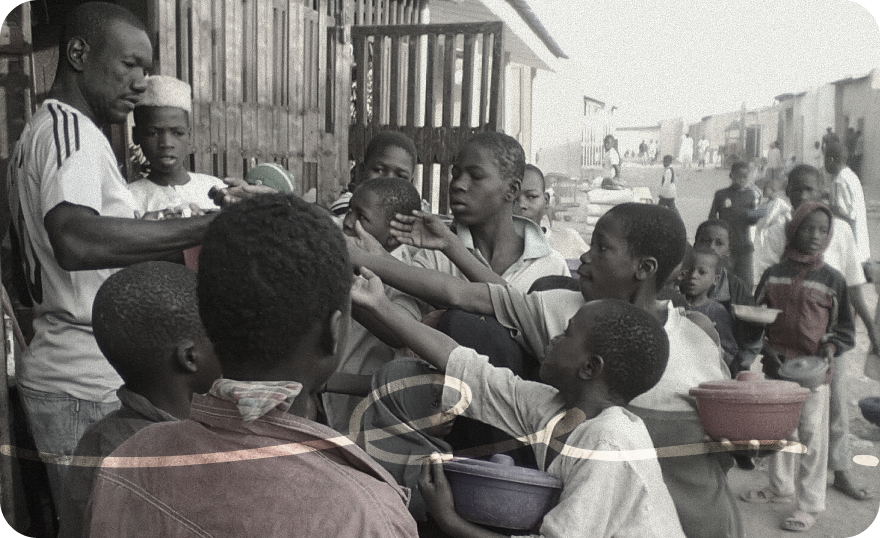
As I crouched behind the rusted kiosk, lost in my thoughts and trying to understand what my mind was playing at, a sharp pain at the back of my head pulled me out of my reverie. I turned around. One of the Dadin Kowa boys towered over Musa and me. We both looked up like rats caught by a predator. Musa looked at me, his mouth moving in slurred speech… I couldn't hear him over the ringing in my ears.
‘Shehu... Shehu... kai Dan iska!!!’
I gasped, all sweaty under the rusted roof of a discarded mechanic workshop.
‘Ehn, yes… ina ji ka,’ I whispered in response. My voice was hoarse and my throat dry, as though I had been starved of water for a decade. Still reeling from the dream I just had, I heard him say:
‘Ta shi muje Salah…’
It was already 4 PM. I had dozed off after Musa and I left Tudun Wada to go look for our next meal… or better still, work for the next meal of our mallams, in Sabon Gari.
We found a borehole nearby where we performed our ablution. There, I drank water to quench my thirst. After prayers, Musa left, saying he was going to inquire if there was sadaqah at Mama Chidinma's kose spot. I was hungry, though too tired to tag along.
So there I was in the mosque, left with my thoughts.
I looked around, watching men disperse, young and old. These men are protectors. Even though I never experienced fatherly protection, I saw how my Mallam cared for his children. They enjoyed the privilege of proper education, a comfortable roof over their heads, good clothing, and a good meal after a long day. I watched a man gently pat his son's shoulder as they walked out together, the boy laughing at something his father said. A hollow, suffocating ache settled deep in my chest. Closing my eyes, I willed myself to hold back the dampness that was threatening to break free and spill down my sunken, malnourished cheek. Not that anyone would notice or spare me a second glance if they did.
An Almajiri meant everything to them but a sincere and helpless child.
A thief? Yes.
A persistent, unrepentant beggar? Yes.
A Hausa tout? Yes.
But a child who was taken away from his family without consent to a faraway land under the umbrella of Islamic education, only to be exploited, manipulated, and left alone to navigate life and survive? No.
A child who has no idea what care, affection, and being treated as important means? No.
I strolled out of the mosque, bowl in hand, on autopilot. The plastic was light, but the burden of carrying it every single day felt heavier than lead. Chanting my usual line, pleading for alms as I went from shop to shop...
“Sadaqah sabo da Allah… fi sabilillah.”
I walked until I entered the motor park. Looking ahead, I saw many young boys like myself - discarded, begging, only to be shooed away. There, among them, I saw Musa. He must have left Mama Chidinma's spot, because he was already blindly doing what he knew best - the only thing he had ever been taught: begging.
Seeing him like that, reduced to nothing but a stretched-out hand, a deep, suffocating wave of self-pity washed over me.
Is this all we were created for?
To be the dirt beneath everyone else's feet?
I looked past him, watching a vehicle packed with passengers screeching its way out of the park to a destination I didn't know. A thought, although fleeting, crossed my mind: What if I ran away?
But of course, I can't.
Where would I go?
Who would accept me without the stigma?
It's a trap, a loop that I was thrown into without my consent. Whatever mistake was made before I arrived here, I have been the one paying for it. I am serving a life sentence on these streets for a crime I did not commit.
This is my reality. It is not rosy, and no, I didn't choose to be this way.
A stranger's tears forced me to wake up to the truth of our existence, but I assure you, most boys like me will never get the chance to open their eyes.
So I, though I know I am not worthy of your love, beg you to treat others like me out there with a little empathy.
I know it can get exhausting to watch us. We always come back, holding out our plastic bowls, pleading for alms. We do it because we have no other choice. A few of us might find odd jobs to survive; the rest of us just stick to what we know. We stick to what is familiar, because it is the only survival we understand.
Until someone decides to speak for us, until someone dismantles this system that breaks our bodies and our minds, we just have to survive.
Because years of hunger and neglect have made us too weak to fight for ourselves.