
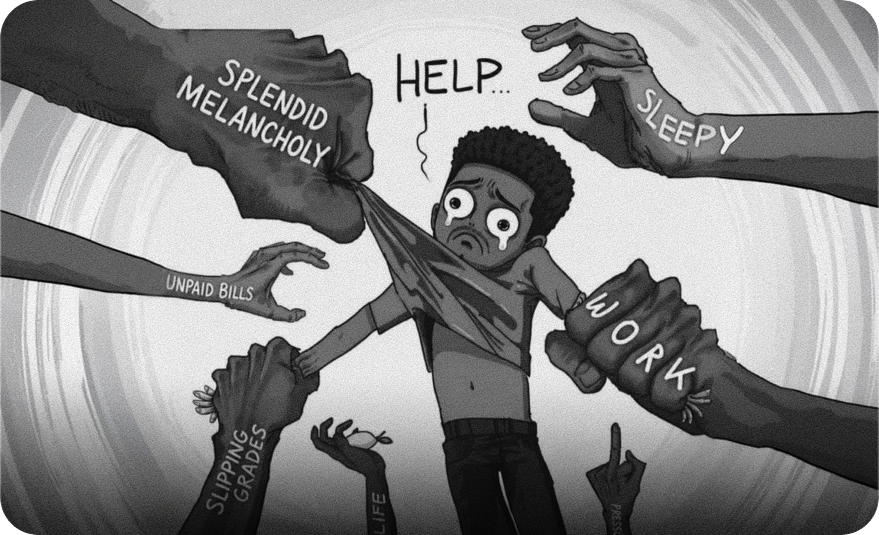
The reality of an average Nigerian student is quietly horrific.
Every night, I lie in bed with a kind of dread that has become too familiar to question. It sits in my chest, heavy and unmoving, as I think about what the morning will bring. Not excitement. Not curiosity. Just the continuation of a cycle I no longer feel in control of.
The looming expenses I have no way of dismissing.
The declining grades I struggle, almost desperately, to improve.
These troubles do not feel like mine. They feel imposed, inherited, unavoidable. That is why I say the expenses, the grades, the fear—as though distancing myself might somehow make them lighter to carry.
I never bargained for this version of life. I never envisioned myself existing in a constant negotiation between survival and self-worth. And yet, here I am.
I like to believe I am not alone in this.
I like to believe there is a quiet, scattered community of students like me—tired, overwhelmed, and trying to find their way out of this deep, consuming well of splendid melancholy we call a university. There is something strangely comforting in that thought, even if it is only imagined.
Because I loved school.
I truly did.
Learning was never a burden to me. It was alive. It was electric. My curiosity found a home in classrooms and textbooks. I remember the way my mind would stretch to accommodate new ideas, the satisfying tension of not knowing, followed by the release of understanding.
The rush of solving a difficult math problem.
The vivid worlds I built in my mind while reading novels.
The quiet joy of discovering something new and realizing I had changed because of it.
I lived for that feeling. I believed it was my calling—to learn, to grow, to understand.
But somewhere along the way, something shifted.
Now, learning feels like a chore.
As a young adult in a country where the economic reality grows more unstable by the day, the weight of financial responsibility has become inescapable. Bills I cannot pay sit in the back of my mind like a constant hum, growing louder with every passing day. With no steady source of income, they become both my first and last thoughts—greeting me in the morning and following me into uneasy sleep at night.
I go to class every day with a fragile hope—that maybe, just maybe, something will reignite that light I once had. That curiosity will return, that excitement will find me again.
But more often than not, that hope is dimmed before it has the chance to grow.
Lectures blur into slides.
Slides turn into notes.
Notes become something to memorize, not to understand.
My brain is no longer a space for exploration. It has been reduced to storage—a temporary holding ground for information that only needs to last until the exam is over. I do not think up new ideas anymore. I do not ask questions that wander beyond the syllabus. I do not chase curiosity, because curiosity is not graded.
Understanding is not rewarded.
Memorization is.
So I adapt.
I read to pass, not to learn.
I memorize to survive, not to grow.
And in doing so, I feel like I am slowly losing something essential—something that once defined me.
I do not know what to prioritize anymore.
My mental health, which quietly deteriorates under pressure?
Or my academic performance, which feels like the only measurable proof that I am still “on track”?
My financial stability, which demands attention I cannot afford to ignore?
Or the pursuit of excellence, which requires a peace of mind I no longer have?
I do not know if the path I chose out of passion has now become a path I remain on out of necessity. I do not know where one ends and the other begins.
There is a constant, underlying fear that defines this experience.
What if it does not work out?
What if all of this effort leads nowhere?
What if I am sacrificing parts of myself for a future that never arrives?
These questions do not come with answers. They linger, unresolved, shaping the way I move through each day.
An average Nigerian student does not just study.
They endure.
They carry expectations, uncertainty, and invisible burdens that rarely make it into conversations about grades or graduation. They wake up each day and choose, consciously or not, to keep going despite the weight.
This is not just difficult.
It is exhausting.
It is a quiet, persistent kind of distress that does not always show on the surface, but is always there, just beneath it.
This is the reality.
And it is, in every sense of the word, horrific.