
I woke up to the call for Subhi. I immediately performed my ablution and jogged to the mosque opposite Mallam Bilyamin's ungwa for congregational prayer. With my forehead pressed to the mat, I asked Allah for direction. I planned to share my thoughts with Musa today, to finally ask him the terrifying question that had been disturbing my rest.
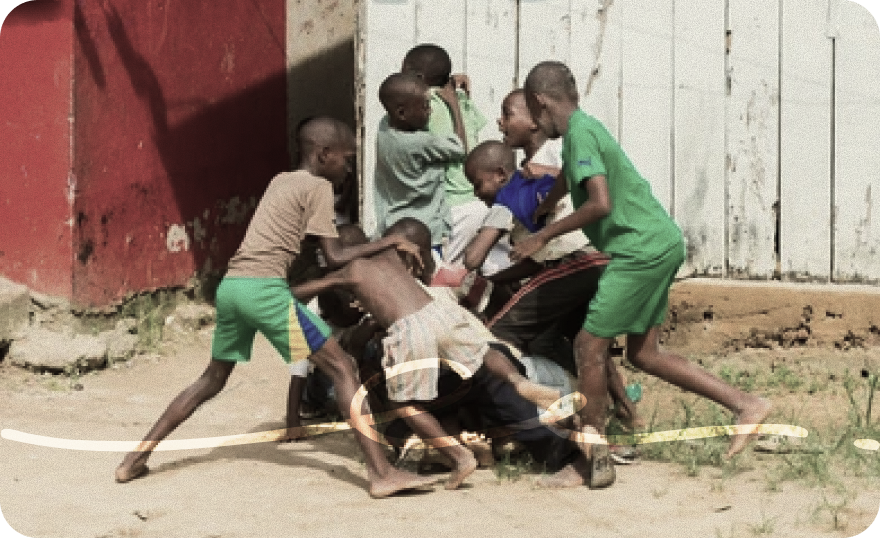
After the prayer, I went to Iya Majid's buka to work in exchange for my breakfast. I had just finished eating when I saw a group of boys sprinting toward Sharandaji with huge sticks and karfe. The desperate thud of their bare feet on the soil told me something was up.
I wasn't wrong. By the time I reached the junction, the street had already erupted. The Dadin Kowa and Tudun Wada boys were always at loggerheads; a bitter hatred that hung over us every single day. It only ever took a small spark to ignite it. What likely started as a minor scuffle or a stray insult had rapidly spiraled. A Dadin Kowa boy had been stabbed by someone from our side. Boys were now armed with rusted knives. Chaos and angry, panicked voices tore through the morning air.
I was deeply familiar with this kind of scene. Normally, I would have blindly thrown myself into the ruckus alongside them, but I just couldn't, not after what had been going through my mind. Now, I also realised how neglected, scorned and abandoned we were. Nobody dared interfere, not for fear of their safety, but because they would rather let us self-destruct. A simple call to Area Command would have saved a lot of young boys from injury, but no one was willing to stop us. Standing at the sidelines, I saw how invisible we were to our community. We weren't worth saving.
I was about to turn and go about my usual routine of begging when I spotted Musa in the chaos, throwing punches with so much gusto like his next meal depended on it. I went to him, avoiding as many blows as possible on my way, and eventually got to his side and dragged his arm. This distracted him, giving his opponent an opportunity to strike him hard on his face, leaving a small tear on his left brow. This only riled him up more. He was angered and shoved me to the side, ready to lunge at his opponent, when a local vigilante truck pulled up.
Immediately, everybody scattered. The loud horn cut through the noise, and boys ran in every direction. Without thinking, I grabbed Musa's shirt. He tried to fight me off, his eyes still wild, but seeing the vigilante men jumping out with their sticks broke his trance.
We ran.
We ran through the narrow paths of Tudun Wada. The rubber shoes the madam bought us slapped hard against the ground as the shouting faded behind us. I dragged him behind an old, rusted kiosk that smelled of stale urine, pushing him down until we were completely hidden from the road.
Musa was panting. He wiped at the blood dripping from the small tear on his left brow. He looked at the red stain on his fingers and hissed.
This was my chance. My heart was beating fast, but in that hiding spot, I had to hit the nail on the head.
"Ka gan kai ka?" I asked, pointing at his bleeding brow. "For what? Wannan halin bai kamata ba…"
He glared at me and shook his head. “Shehu Dan Allah, kar ka dame ni…" he said, asking that I let him be, but I persisted.
"See, this is not the life we are living. Don't you stop to ask yourself why no one tried to stop the fight? Why they let us kill ourselves? Honestly, since the encounter with that madam, I have been thinking. Don't you think there's something wrong with the way we are raised? Why would everyone just sit idly by and let us fight ourselves to death?”
He seemed to be taking in all I was saying, so I continued…
“Musa, this isn't the right way to live…”
“Kai Shehu, shut up!” he yelled.
“What is the right way to live? This violence is part of who we are. Our mallams are right in their teachings too. Don't try to diminish their work and immense love for us because of that infidel... mere tears! Shehu, you are better than this.”
“But…”
“Aah aah, no. I won't let you talk like that. Don't lose yourself. See, I know you are tired sometimes, not knowing who you are or where you're from. I can understand your pain. But you're an Almajiri. You have to accept your reality. The fights. The hunger. The hustle. The neglect. It's all part of who you are. It is the will of Allah, and our mallams are never wrong.”
A different kind of fear gripped me. I looked at the absolute conviction in his bleeding face and realized how deep this went. To boys like us, our mallams are holy. They are never wrong. Questioning them wasn't just forbidden; it was something we didn't even know how to do.
For the first time, I felt the terror of my own mind. What happens when a mind that has been trapped for so long decides it wants to think for itself?
A heavy doubt settled in my chest.
What if I am the one who is wrong?
What if my questions are just the whispers of a straying soul, and the mallams really are right?
If I kept pushing Musa, he wouldn't understand. He might even tell the others that my faith was failing.
I would become an outcast among my own kind. The fear of being completely alone, of losing the only brothers I had on these harsh streets, ate away at my resolve.
And with that, I swallowed my words. I lost all of my courage to talk to my friend Musa. He is far gone. My questions about the sincerity of our mallam's teachings will never make sense to him.
He has lost the will to think for himself, to differentiate between right and wrong outside of what we've been told.
And now I wonder, if I am terrified of my own thoughts, and my best friend won't listen to me, who will? With no one to turn to, how do I start a rebellion when I am not even sure of my own mind?