
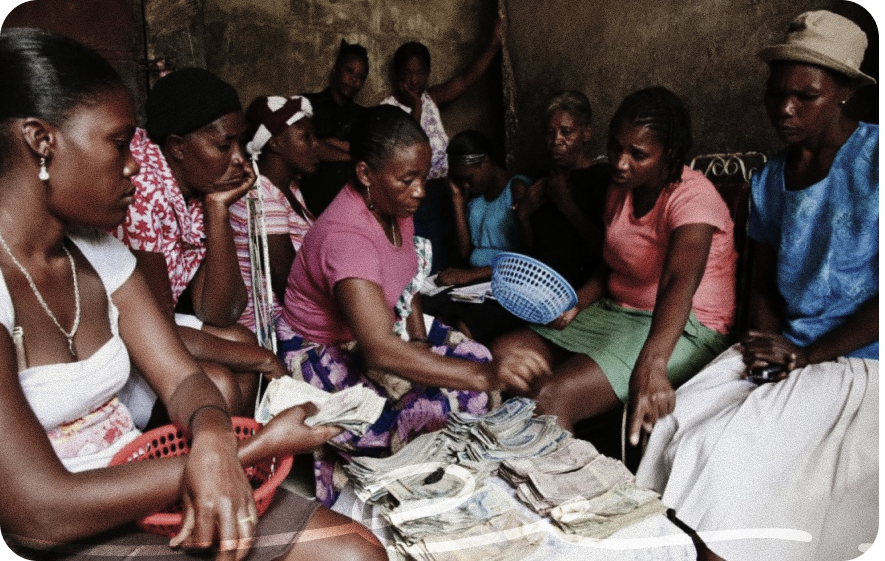
Every month, on the last Sunday, plastic chairs start to make a circle in our yard before the sun goes down. No signs. No Excel files. No official announcements. People, mostly women, are coming in quietly with a purpose. People will give and receive money here, not in the loud, businesslike way of a bank or any other legally binding buying and selling, but in a gentler, more planned way. One by one, contributions are made. Names are called. Laughter slips in between seriousness. And then, at a moment that feels almost ceremonial, a lump sum is handed to one member of the group.
This is Ajo. "We call it Ajo in the streets, but in the books of our heritage, it is Esusu or Adashe in the Hausa language."
Esusu is more than a contributory scheme; it is a cultural heritage masquerading as an informal system. To the uninitiated, it looks like nothing more than a monthly gathering—parents in living rooms, the rustle of ledgers, the clink of teacups. To a feeble mind, it’s just a meeting.
But to the dreamer, Esusu is project financing. It is the invisible scaffolding that enables individuals to build houses, pay school fees, and launch businesses. It is a "cooperative" in its most primal, honest form—a reliance on one another that bypasses the cold bureaucracy of formal banks and provides immediate access to capital.
Oh, how feebleminded I was. In parts of my rural community, Assiga, in the Yakurr area of Cross River State, there is something called Gogina, where subsistence farming isn't just a job but a lifeline.
This spirit of working together becomes more real.
By early morning, a group of farmers meets at the edge of a farm. No money changed hands. There are no contracts.
But work starts with a sense of excitement that paid work rarely has. Hoes hit the ground in time. The bush is clear. The ridges are up.
By noon, what would have taken one person days to do is almost done.
They move with the same group to another farm and start the cycle over again.
When the work is done, they sit together, eat yams, and drink palm wine.
They are not workers paid for their services, but people who are part of a system that ensures no one is left behind.
Twenty hands move like forty.
Gogina is a system built on the twin pillars of trust and capability.
It is a rotating labor force where groups of farmers agree to become each other’s strength.
They rotate through the seasons—clearing land, mounding ridges, weeding, and harvesting—transforming weeks of backbreaking individual toil into a single day of communal triumph.
These systems are extraordinary not only for their existence but also for their persistence.
In growth-and-development talk, frameworks like these are often called "informal," which suggests they are not yet complete, as if they are waiting to evolve into something more structured, more legitimate.
But that way of putting it misses the point.
These systems are not just parts of formal institutions. They are different kinds of institutions that are context-based, culturally supported, and built to last.
In Esusu, money is moved around instead of being borrowed. Rotational liquidity.
In Gogina, people exchange labor instead of selling it.
Both systems address the same core issue: how to create movement in environments with limited resources.
In Esusu, you don’t just save—you enable someone else’s beginning.
In Gogina, you don’t just farm—you multiply effort through community.
This is the quiet logic of ''I rise'', “we rise.”
It is not charity. It is not a dependency. It is coordination. known as operational logic
And perhaps that is the most overlooked insight.
A lot of stories about African economies still focus on what they don't have, like infrastructure, capital, and standardized systems.
But applications like Esusu and Gogina go against that story by not denying these limits but finding ways to work around them.
They show that economic life doesn't stop when there is no formal structure.
It adapts.
It reorganizes.
It finds other ways to function.
This is not to romanticize these systems. They have limits. They rely heavily on trust, which can be strained. They operate on a smaller scale. They do not replace the need for broader infrastructure.
But they do something equally important
They sustain motion.
And in many cases, that motion is the difference between stagnation and progress.
Both Esusu and Gogina are anchored in one powerful thesis: Advancement is mutual.
This is not just philosophy but practical logic—it establishes inclusion, reliability, and generosity.
It doesn't coerce; it sets communal expectations.
Over time, it fosters an economic life that is communal yet equips individuals to succeed.
In a world dominated by formal measures, these systems remain largely invisible but offer vital, cooperative pathways to progress.