
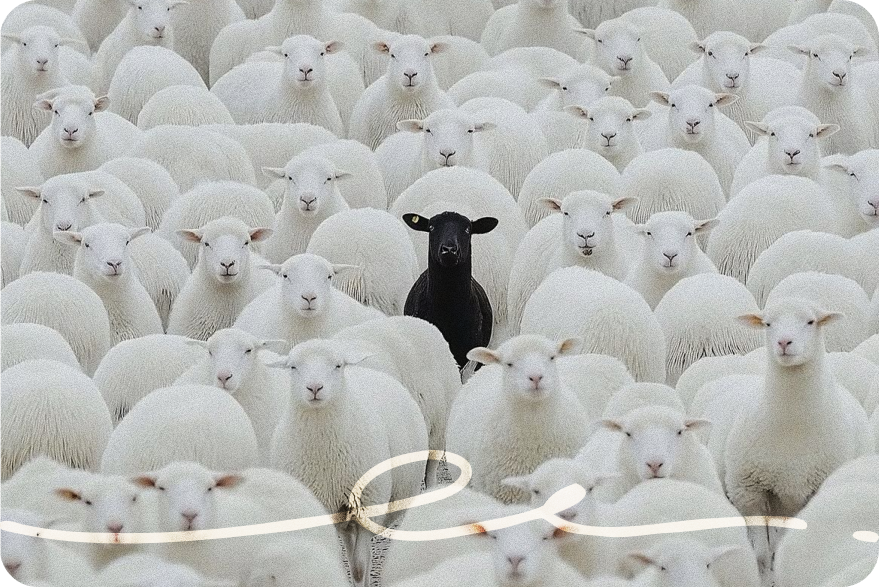
The human need to belong often pushes us into slowly erasing the version of ourselves that matters the most. The real you. We change how we speak, think, and act until we can be accepted at the cost of authenticity. What appears as harmless adaptation can become quiet conformity. To be accepted, we sometimes become less of ourselves we can barely recognize.
Belonging is not optional. You can't choose to not belong, or you might just fall out forever. It is considered an anomaly and therefore it is deeply human to belong. From family circles to friendships, from classrooms to social spaces, there is an unspoken pressure to fit in. No one teaches it or says it out directly, yet everyone understands it, the importance. There are ways to speak, ways to behave, ways to exist that seem to guarantee acceptance.
And so, we learn, we observe what is praised and what is ignored and then we adjust accordingly. At first, it feels natural like growing into a new show or clothe. But over time, the line between adaptation and complete alteration begins to blur. What started as small adjustments becomes a pattern. One that must be fulfilled and when enter new spaces, we reshape ourselves to survive in those spaces.
In the pursuit of belonging, we suppress ourselves more than necessary, we often silence parts of ourselves that feels inconvenient to others or out of place. Opinions are softened. Behaviors are adjusted. Certain truths remain unspoken.
Not because they are unimportant or wrong but because they may threaten acceptance.
We begin to ask silent questions. Will this make me seem different?, will I still be accepted if I say this?, and slowly, we learn to edit ourselves. Belonging sometimes begins with hiding parts of ourselves we think is unnecessary. It is rarely dramatic but happens in small moments. Moments we barely take note of. In moments when we choose not to speak, moments where we laugh at what we don’t find funny and agreeing when we feel otherwise. These moments seem insignificant But over time, they accumulate and what is lost is not loud but it is becomes real.A thought not being expressed, a version of yourself not seen and eventually we become the version others want us to be.
When we eventually succeed in fitting in, the belonging we experience and once craved for is often incomplete. It is acceptance, but of a version we have constructed, not our full authentic selves and somewhere within that acceptance, there is a quiet awareness, a quiet question we ask. If they knew everything, and we didn't have to hide anymore, would we still belong?. Acceptance without authenticity is only performance. A stage performance for an unworthy audience. There's a subtle disconnection. We are present, but not fully known, included, and yet not entirely understood. Over time, this can lead to a deeper internal conflict with ourselves. The desire to be accepted and the need to be real and when these two do not align, something begins to strain. Belonging should feel like ease, something to breeze through and not effort. Yet fitting in often feels like constant adjustment. Belonging in a place where you always need to perform is exhausting.
It can be argued that adaptation is necessary. I completely agree. Society requires a level of adjustment for harmony to exist. Without it, chaos would replace connection. Learning to fit into different spaces can be seen as a sign of growth, maturity, and social intelligence.
We must learn to bend a little and this is true to a point. Not all change is loss and not all adjustment is harmful but the danger lies in excess. When adaptations becomes transformation, flexibility becomes erasure and when belonging requires abandoning parts of ourselves, then what we gain externally, we lose internally.
Growing into a space is completely different from shrinking for it.
Belonging is powerful in it own way. I know this without a doubt but it is not meant to cost us ourselves. While trying to change ourselves we risk becoming strangers to who we are. Not suddenly, but gradually through small silences, small adjustments, small compromises. Until one day, the question becomes unavoidable. Was I accepted for who I am or for who I've learned to be?
"The deepest loneliness is not being alone—it is being unseen in a crowd". True belonging does not demand performance. It does not require constant adjustments. It allows presence without pressure and perhaps the real challenge is not finding where we fit in the first place but finding where we no longer feel the need to.
"Belonging should not ask you to disappear to exist"