
Dear Conquered Generation,
A quiet sadness settles over me whenever I sit in a room full of brilliant minds and realize how lonely we have become. Perhaps we were not conquered only by foreign powers, failed governments, or broken institutions. Perhaps the deeper conquest occurred the moment we stopped seeing ourselves as a collective destiny and began treating individual survival as our highest priority.
We became masters of the exit strategy but entirely forgot the art of construction.
It begins with the quiet philosophy of “every man for himself”—a mindset that masquerades as survival but slowly hardens into a way of life. We enter into a silent moral bargain with our surroundings: as long as our own space is secure, the wider disorder is not our concern. If injustice does not reach our doorstep, we tell ourselves we are safe. In that comfort, we abandon collective sensitivity. We stop reacting to societal injury as a shared wound and begin treating it as a distant inconvenience, unknowingly strengthening the very systems that depend on our silence.
Look around us. We mastered the art of creating strong individuals but forgot how to build strong institutions.
A cold numbness has crept into our daily lives, quietly reshaping how we relate to one another and to the very idea of home. Each person has learned the exhausting mechanics of becoming their own local government. We have engineered our lives around verbs of flight and fortification: to leave, to hustle, to survive, to fence off a small corner of private comfort, and to fiercely guard our personal ambition. We celebrate these isolated victories loudly on our feeds, amassing private strength while the ground beneath the collective slowly turns to dust.
But a difficult question arises when we look at what is left behind. Nations are not sustained by scattered successes or individual escapes. We became a society of brilliant self-made individuals who can dig their own boreholes and fund their own private security yet remain a fragile collective. A society weakens when its brightest minds no longer ask, “How do we build this system together?” and instead whisper, “How do I become strong enough to bypass the system entirely?”
Public institutions weakened not because of individuals who ran them alone, but because fewer of us felt attached to them. Public processes faded into the background, civic obligation blurred, and trust—the unseen framework that held everything together—began to dwindle. When trust erodes, collective strength silently follows.
We must face an uncomfortable truth: a conquered people are not only those ruled by external forces. Sometimes, they are people who have long stopped believing enough in one another to lay down a single brick for a shared future. True freedom is not merely the ability of individuals to leave, relocate, or reinvent themselves elsewhere. True freedom is the sacred capability of a people to organize, to trust, to sacrifice, and to build institutions that outlast their individual lives.
Perhaps that is the central tragedy we carry: we inherited broken systems, but instead of interlocking our efforts to rebuild them, we turned survival into a private, isolating project, creating islands of personal success in an ocean of collective failure.
And yet, maybe this is where reversal begins.
A difficult truth is that we cannot permanently substitute private survival for failed public systems without eventually weakening both. What feels like personal safety is often only a temporary shield against a deeper structural decay.
We have learned to construct private remedies around public failure, but in the process, we confuse individual protection for collective advancement.
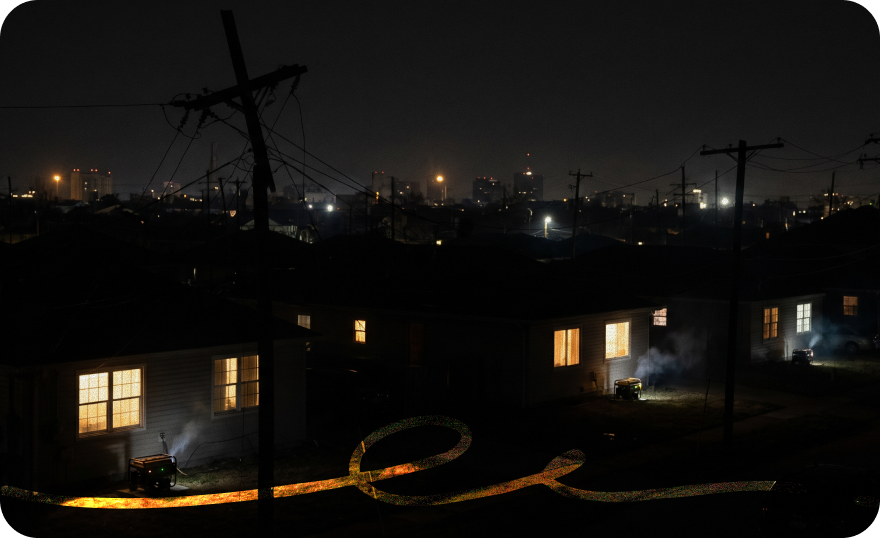
A private generator or solar system may solve an individual’s power problem, but it does not exempt anyone from the reality of a failed national grid, one that is meant to power industries, reduce production costs, and sustain economic growth for everyone. A private security guard may protect an individual's home, but it does not replace a broken public security system meant to guarantee safety for entire communities, enable economic activity, and preserve the trust that allows a nation to function without fear. A personal escape may create safety for one individual elsewhere, but it does not repair the conditions that make a nation unlivable in the first place, nor does it restore the institutions, opportunities, and stability required for those who remain to build a functioning society.
The moment we recognize that private strength cannot substitute for collective structure is the moment the walls of our isolation begin to crack, and something more enduring begins to return.
Because no society survives for long on isolated strength.
We must understand that private comfort cannot repair public failure, no matter how efficiently we adapt to it. At some point, adaptation stops being resilience and becomes surrender dressed as survival.
Because no society is rebuilt by isolated success stories.
It is rebuilt when people choose to act—by reaching out, collaborating, and investing effort in shared projects that restore trust and build lasting institutions to strengthen our collective future.
The real moment of awakening is this: when we finally understand that what we call individual survival has been quietly borrowing from a collapsing collective all along.