
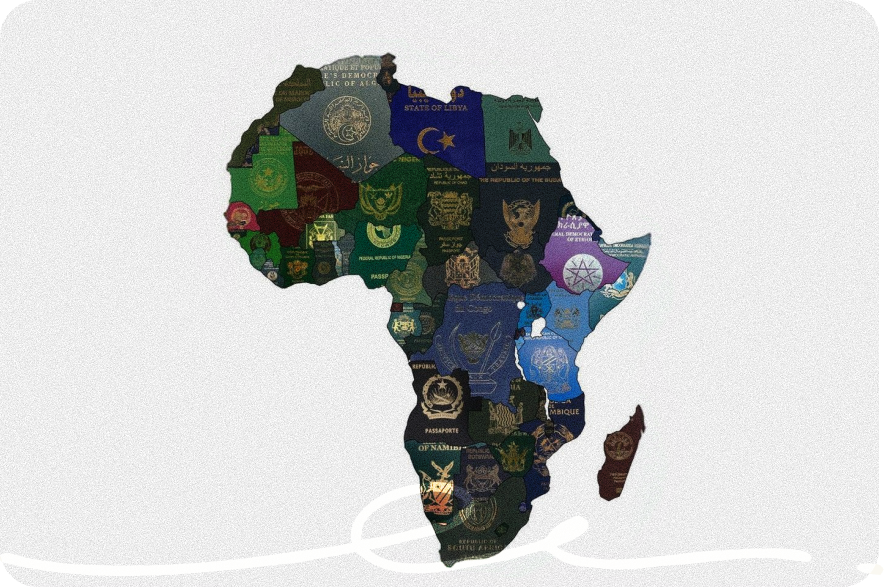
It is unsettling how something as small as a passport stamp can make you feel like an intruder on your own continent. Not in Europe. Not in America. But here, Africa. You arrive at the airport, and before your feet fully adjust to the new soil, your identity is already on trial. The questions are familiar but never neutral: Why are you here? Who is funding you? Can you sustain yourself? They are not just administrative, they are suspicious. You are not simply entering a country; you are being assessed, weighed, and quietly doubted. And the irony is difficult to ignore. You look like the officer questioning you. You share histories, textures of language, inherited struggles. Yet, in that moment, you are “other.”
This is the contradiction of African migration: we are foreigners to one another on a continent we collectively call home. We often justify strict scrutiny when Africans travel outside the continent. It makes sense; different continents, different systems, different stakes. But what explains the tension at borders between neighboring African countries? Places separated not by the great Atlantic ocean but by lines drawn across land we once moved through freely. Those lines were never ours. They were inherited, etched by colonial hands that carved territories for control, not connection. And yet, decades after independence, we have not only preserved those borders; we have internalized them. We defend them fiercely, sometimes more against each other than against the systems that created them.
There is fear, of course. Real fear. The fear that open borders could become entry points for insecurity, crime, or instability. The fear that trust might be exploited. These concerns are not imaginary, and they cannot be dismissed with idealism. But beneath that fear lies something deeper and more uncomfortable.
A quiet erosion of trust among ourselves.
We have learned to see one another through the lens of nationality first, humanity second. A Ghanaian is not immediately kin to a Nigerian. A Kenyan is not instantly familiar to a Senegalese. Instead, we approach each other with caution, sometimes even hostility, as though proximity has made us competitors rather than collaborators. And yet, history tells a different story.
There was a time, long before passports and visa regimes when movement across this continent was not an act of permission but a rhythm of life. Trade routes stretched across regions. Cultures overlapped. Languages differed, but connection remained. Identity was fluid, not boxed into nation-states. We did not need documents to recognize each other. So what changed?
Colonialism did more than divide land; it disrupted perception. It introduced artificial separations and then left us to manage them. Over time, those separations hardened not just politically, but psychologically. We began to see borders not as temporary constructs, but as necessary defenses. And in doing so, we absorbed suspicion as a default response. Today, even as conversations about a “borderless Africa” gain traction through policies, agreements, and frameworks; the deeper work remains undone. Because a borderless Africa is not just about removing visa requirements. It is about unlearning distrust.
It is about confronting the subtle ways we police each other’s presence. It is about asking why we are more comfortable extending grace outward, but not inward. Why we question each other’s intentions before we acknowledge our shared realities. Policy can open borders, but it cannot force belonging.
That has to be rebuilt deliberately, patiently, and honestly. It begins with how we encounter one another in everyday spaces: at airports, in classrooms, in workplaces, in stories we tell about each other. It requires curiosity instead of assumption. It demands that we see beyond accents, beyond passports, beyond the invisible hierarchies we have constructed among ourselves.
Because even if every African country became visa-free tomorrow, something would still feel off if suspicion remains. We would move freely but not fully belong.
A truly borderless Africa is not just geographical. It is emotional. Psychological. Cultural. It is the ability to arrive in another African country and feel, instinctively, that you are not out of place. That recognition will not come from stamps on a passport.
It will come from a shift in how we see each other, not as risks to be managed, but as kin returning through different doors.