
This story is from two perspectives.
How did you measure your growth as a kid? I'm sure if I asked ten people this, I'd get at least seven of the same answers from them. “Checking my height”, “Outgrowing my clothes”, “Increase in strength or stamina” and any other ones you can think of.
The truth is there are a lot of ways and they are all valid and special to every childhood. But one that strikes a lot of importance to this story and one way I got reminded of today is my sitting posture on a bike, ‘okada’. I like this one because it creates two different realities; both linked into one.
For Eniola and Hamirat, two siblings in a line up of six, growth is important and pans out in different ways but with a shared experience, “their okada ride experience.”
Yes, it's as weird and funny as it sounds but I'm sure a lot of people can relate to this. Let's explain.
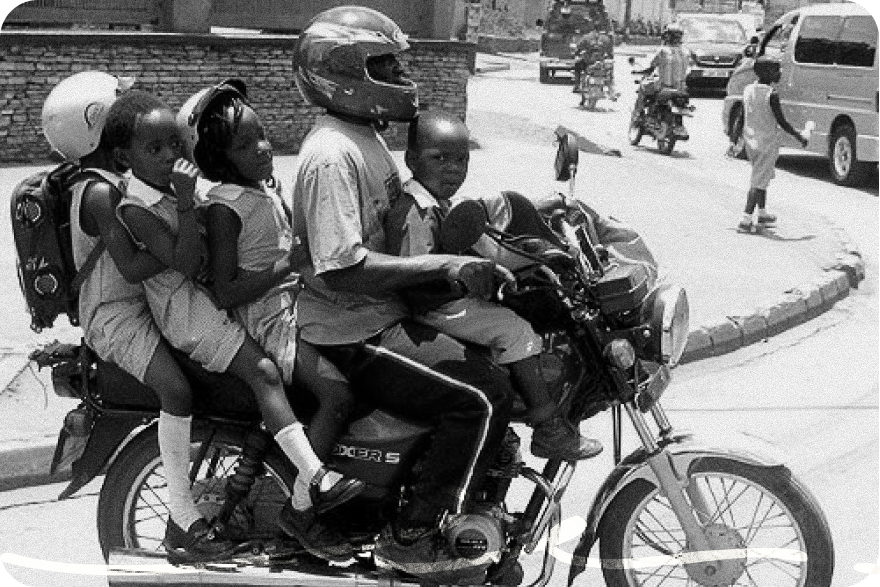
Think back, far back as you being between seven to ten years old, imagine an okada ride with your mom to the market or somewhere else or in our case, an okada ride to and from school. My siblings and I never took the school bus, bikes were cheaper and we had our dedicated and
designated okada man- Baba Pupa ( lovely man). Back to the point.
Picture yourself on this okada, and as a young child, you are definitely short, so your feet are not resting on anything. How would you sit? It seems like an easy answer, you simply sit behind the okada man, your arms wrapped tight around his body so you don't fall off. Your weight is still not enough to keep you balanced on the smooth leather seat so you are also resting on his back, your legs unable to ‘touch the ground’ so they are just there hanging on both sides.
With all this going on, Eniola is worried about his oversized shoes falling off (perks of never finding his shoes that fit well), his focus is channelled on keeping his feet pointed to the skies to keep his shoes from falling off, a visible struggle that requires all his leg strength making his posture even more uncomfortable with his back leaning backwards away from his anchor, the okada man's body.
For Hamirat, it's always been a very different experience, she never really worried about her sitting posture. Most of her life, she enjoyed the last born and subsequently middle child benefits of either being in the front seat with the bike man placing her right under his scrutiny or she was perfectly sandwiched among her siblings at the back seat enjoying the views and seeing the same sights everyday; other school children, early traders, people rushing to get any form of transport. She didn't get to worry about balance until she was old enough to take an okada ride alone and even then her only problem was her body leaning more to her right than her left, something she still struggles with.
Every ride becomes not just a physical challenge but a full mental equation with calculations, road bump analysis, situational crisis and unconscious okada riding abilities. It's worse when you leave home with so much tension and chaos, someone's missing lunch bag,untied shoes, worst case scenario, you remember you forgot that civic workbook that's due for submission by second period. Fun times!
Or that one time Hamirat fell off a bike, but even then she didn't have time to focus on losing her balance, she was more concerned about protecting her sisters from the kidnapping okada man and making her way away from an angry mob who somehow developed a savior complex and were seconds away from lynching the runaway okada man. Long story short, they all ended up in the police station.
Growing up through all that meant the day your legs were finally able to balance on those rungs, you were no longer a kid. You have made it! Now you get to sit and enjoy the breeze on your face (the same breeze you once feared could and would knock you off the okada) and the sights during the journey ( the same sights you once spent time creating realities and stories for and still do).
I believe this measure of growth should be ranked high, if not higher than the others because it combines physical, mental and spatial awareness like you'd never imagine. It also provides a more obvious realization of the seasons you have experienced and how far you've come. We don't take okada rides as often as we used to for different reasons. It's been years since we had that shared experience but that in itself is a form of growth. Eniola navigates a different life than Hamirat, both of them carving out different paths in different cities with different people and situations.
How did you measure your growth as a kid? I'm sure if I asked ten people this question, none of them would give me this answer.