
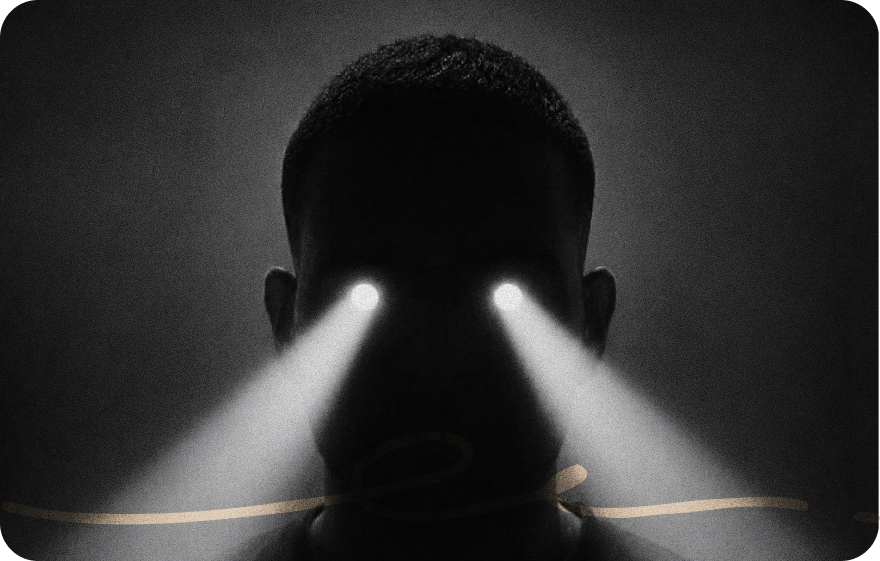
You know that moment when the lights suddenly go out and you're trying to find your way back to your room?
For some reason, keeping your eyes open doesn't seem to help much. But the moment you close them, you somehow feel more aware of your surroundings and can navigate a little more confidently. I've experienced that before, and it always made me wonder what was actually happening.
So I did a little research.
What I discovered was something called phosphenes—visual sensations of light that occur even when no actual light is entering the eyes. Fascinating, right?
When you're in complete darkness or have your eyes closed, your brain doesn't simply stop processing visual information. Instead, the visual system continues to generate activity, which can appear as faint lights, patterns, shapes, or flashes. These experiences are known as phosphenes.
Phosphenes are visual sensations of light that occur without any actual light entering the eyes. They may appear as flashes, sparks, geometric patterns, or swirling colors and can be seen when a person closes their eyes, rubs their eyes gently, or experiences changes in pressure on the retina. Although they may seem mysterious, phosphenes are a normal result of activity within the visual system.
At this point, you might be wondering: "Is this how blind people see?"
The answer is not exactly.
Blindness exists on a spectrum. Some blind people can perceive light, shadows, or movement, while others have no visual perception at all. People who are completely blind from birth often don't experience vision the way sighted people imagine it. Their understanding of the world comes primarily through touch, sound, smell, and other senses rather than visual images.
The phenomenon occurs because the retina and visual cortex can generate signals even in the absence of external light. When the eyes are closed in a dark environment, the brain continues to process electrical activity from visual neurons. This activity can create the perception of light, causing a person to "see" shapes, colors, or patterns that are not actually present in the surrounding environment.
Phosphenes have fascinated scientists and philosophers for centuries. Researchers study them to better understand how the brain constructs visual experiences. Astronauts have reported seeing phosphenes in space, where cosmic rays interact with the visual system and produce flashes of light. These observations have provided valuable insights into both neuroscience and space medicine.
The experience of phosphenes demonstrates that vision is not solely dependent on light entering the eyes. Instead, it highlights the brain's active role in creating our perception of reality. What we see is not simply a direct recording of the world around us but a complex interpretation generated by the nervous system.
However, some blind individuals can experience phosphenes, especially if parts of their visual system are still active. But phosphenes are not the same as normal sight—they are simply sensations of light or patterns created by the brain.
What's even more interesting is that this phenomenon reminds us that seeing isn't just about our eyes—it's also about our brain. The brain is constantly interpreting signals and constructing our perception of the world, even when there is little or no light available.
So the next time you're standing in a dark room and feel like you can "see" a little better with your eyes closed, remember: your mind may be doing more of the work than you realize.
phosphenes are a remarkable example of the brain's ability to produce visual experiences without external stimuli. They reveal the intricate relationship between the eyes, the brain, and perception itself, reminding us that the act of seeing is as much a function of the mind as it is of the eyes.