
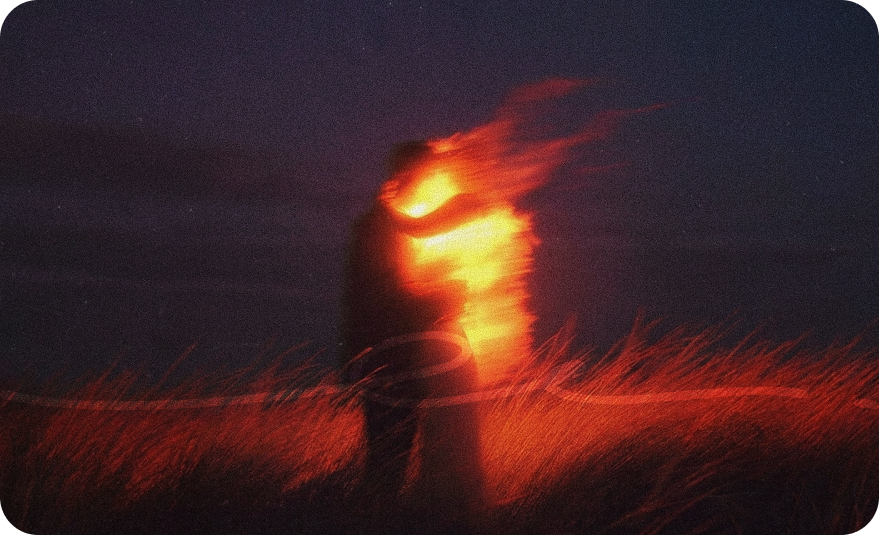
I remember the exact moment I convinced myself I wanted her back. She had posted a photo. Nothing dramatic, just her laughing at something off-camera, someone else's hand visible at the very edge of the frame. I stared at it longer than I should have. I told myself the feeling in my chest was love.
It wasn't love. I know that now. But the body doesn't care much for distinctions. It registers the signal and starts reaching.
So I reached out. A text, something casual, something that left room for her to respond or not. She responded. We talked the way people talk when they are being careful with each other, feeling for soft ground. Somewhere inside those messages, I managed to convince myself that I had always missed her, that something in me had known we weren't done.
She came back. Or I came back. The direction was never quite clear.
The first week felt the way I had imagined it would. Warm and familiar, like returning to a city you once lived in and finding your body still remembers the streets. I thought: see. This is what I knew was still here. And I believed it.
Then the third week arrived, and the feeling did not.
It is strange to watch an emotion dissolve in real time. You keep reaching for it, and your hand closes around air. The happiness I had pictured, the version of us I had been carrying around for months, had been built entirely in her absence. Distance had edited us. It removed the friction, the long silences after arguments, the specific way our rhythms never lined up on Tuesday evenings. All of that had softened in memory. What remained were only the good parts, arranged like photographs in an album that someone else curated.
And here is the thing nobody says plainly: the reaching was never really about her.
It was about the photo. The hand at the edge of the frame. The idea that she was somewhere, continuing, building something, and I was no longer the reason for any of it. That is what triggered the reaching. Not love. Something older, something more animal. The refusal to be left without consent.
When you are apart from someone, you do not think about the tension. You think about the night you laughed until your stomach hurt. You remember a particular afternoon, light coming through a window at a certain angle. The mind keeps the image and quietly discards the context. Then you mistake the image for the whole of it.
So you go back. And reality is always smaller than the story you told about it. It has to be. The story was constructed in a kind of grief, and grief is an unreliable architect. It builds rooms that do not exist.
She noticed before I said anything. I saw it in the way she stopped reaching across the table. Her responses got shorter, not unkind but measured. She was recalibrating. She had probably felt it too, that same flatness where the warmth was supposed to be.
I didn't say anything. Neither did she.
That is the part that stays with me. Not the ending, but the moment just before it, when we both knew, and we sat with that knowledge in the same room, and the thing I had wanted so badly turned out to be something I had already let go of a long time before.
I just hadn't noticed until she was standing right in front of me again.