
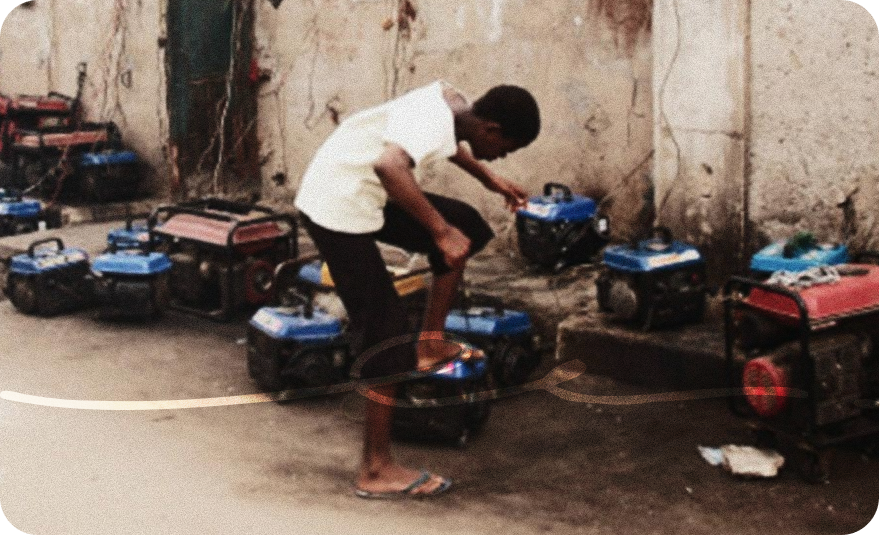
Picture a neighbourhood on a hot afternoon. The power goes out again. Within minutes, the street erupts in a familiar chorus: generators roaring to life, one after another, every household retreating behind its own private electricity. Nobody suggests pooling resources. Nobody drafts a petition to the electricity authority. Everyone manages their own corner of the crisis and minds their business.
This scene is unremarkable to most Nigerians. Yet it captures something profound a tendency toward self-preservation and individual advancement that, taken to its extreme, corrodes the foundations of communal progress.
Nigeria is a nation of extraordinary, resilient, and ambitious people. But beneath this vitality runs a troubling current: a deeply embedded culture of selfishness and one-upmanship. Personal ambition is a hallmark of the Nigerian spirit, yet the absence of a corresponding civic culture is one of the most underappreciated forces holding the country back.
The Roots
Nigerian selfishness is not a simple moral failing, it is a survival instinct hardened by a corrupt government, Decades of misrule, looted treasuries, and collapsed institutions taught ordinary Nigerians a lesson more powerful than any civic education: the state will not save you, so looking after your own stops being selfishness instead it becomes common sense.
At its most visible, it manifests as relentless status competition. Weddings become battlegrounds. The size of the hall, the calibre of the musician, the quality of the aso-ebi all benchmarked against the last notable event in the social circle. This performance of success actively distorts financial priorities and drives people into debt.
Deeper still is ethnic loyalty over national identity. Nigeria's over 250 ethnic groups have never fully resolved the tension between tribal allegiance and citizenship. Jobs go to kinsmen, contracts to in-group members, and civic spaces are governed by the logic of "what's mine" rather than "what's ours."
Paradoxically, religion amplifies rather than moderates these tendencies. Nigeria is one of the world's most religious nations, yet the dominant prosperity gospel frames divine blessing in deeply individualistic terms your miracle, your breakthrough, your harvest. Communal ethics receive far less pulpit airtime than personal elevation. The result is a society that prays fervently and yet litters freely; that tithes generously and yet bribes casually.
Everyday Manifestations
The generator mentality extends this pattern broadly. When President Tinubu removed the fuel subsidy, filling stations with existing stock immediately hiked their prices not because costs had risen overnight, but because the moment permitted it. It was extortion disguised as market logic. Rather than organising to demand better infrastructure, Nigerians invest privately in generators, boreholes, and private schools. Each choice is individually rational. Cumulatively, they reduce pressure on government to perform and make the idea of shared public goods feel increasingly foreign.
Nepotism institutionalises selfishness further. In Nigerian workplaces public and private "who you know" routinely outweighs "what you can do." This misallocates talent, rewards loyalty over competence, and closes doors on merit.
At the Top
If everyday selfishness is corrosive then its political expression is catastrophic. Bola Tinubu's 2023 campaign slogan "Emi lo kan" ("It is my turn") was widely criticised as naked political entitlement. But the phrase revealed something more troubling than one man's ambition: it resonated because it mapped onto a logic Nigerians already understood. In a political culture where office has historically been the primary vehicle for wealth where governance and self-enrichment are barely distinguished "my turn" is not shocking. It is honest.
Imagine a Nigeria were our leaders are selfless the country will be in a better place, Instead Nigerian political history is largely a history of elite self-enrichment at public expense. The scale of looting documented by the EFCC is staggering governors who emptied treasuries, oil revenues that evaporated, infrastructure funds that built nothing. The tragedy is not just the theft, but the near absence of shame in a culture where getting yours, by any means, is the primary norm.
The Cost
The consequences are immeasurable. Institutions weaken when everyone optimises for personal gain, tax evasion becomes normal, corruption tends to thrive, electoral integrity is sacrificed, Social trust erodes and patriotism becomes a myth . Research consistently shows that low-trust, individualistic societies grow more slowly and suffer higher costs across every sector of the economy.
The Way Forward
Much of this behaviour can be traced to decades of governance failure. When the state cannot be trusted, private solutions make sense. Still, the solution must begin with citizens setting aside ego and entitlement to collectively hold government accountable, Taking for example South Korea in the 1960s was a low-trust, patronage driven society scarred by war and institutional decay. Within a generation, a combination of civic education, anti-corruption enforcement, and deliberate investment in public goods shifted the culture. It was not painless, and it was not fast but it happened.
The energy that drives individual Nigerian success evidenced by the diaspora's remarkable achievements worldwide must be redirected inward. The missing ingredient is a collective decision that our neighbour's progress is not a threat, but a foundation. That building together builds faster than building alone.
The generator chorus may yet give way to something quieter, and far more powerful.