
It began as a small leak on Abiona Street. A government water main, buried beneath the asphalt long before the current republic was formed, finally broke down. At first, it was just a trickle. A small, muddy puddle formed, staining the tyres of passing cars and annoying pedestrians heading to the market.
During the first week, the residents did what Nigerians do best: they complained. They cursed the water board, they complained about the local government chairman, and they lamented the state of the nation. "Look at this mess," the elders would say, shaking their heads and pulling up their trousers to avoid the mud. Commuters grumbled as commercial tricycles splashed dirty water onto their polished shoes. Everyone agreed it was a disgrace.
By the third week, the complaints began to fade. The outrage had died down, making way for our national instinct: adaptability. The puddle had grown into a small lake, completely blocking the pedestrian walkway and encroaching on the road. Wasiu and Chuks, two young boys from the neighbourhood, saw a chance. They pulled an old, heavy wooden plank and put it across the deepest part of the water. They charged a toll of ₦50 to anyone who wanted to cross without getting their work clothes dirty.
By the second month, the leak had become a permanent part of Abiona Street, and a whole micro-economy had grown up around it. Wasiu and Chuks made a stronger, wider bridge out of three planks that they nailed together. They raised the toll to ₦100, saying that the cost of wood was going up and they had to work harder to keep it up. Baba Risi, a local vulcaniser, moved his wooden shed fifty metres down the road so that it was next to the puddle. He charged drivers to wash the tyres of cars that got stuck in the mud with the water that had pooled. A woman set up a kiosk next to the crosswalk during rush hour to sell cold water, Gala, and clean water to people waiting to cross.
The broken pipe was no longer an issue. It had become a business. People started to include the puddle in their daily lives because it became so common. Moms gave their kids extra money for the bus or train ride to get to "the bridge money." Commercial drivers knew exactly how to get through the crater without damaging their shock absorbers. During the election season, a local politician came to campaign, but he didn't say he would fix the pipe. He instead gave Wasiu and Chuks a stronger piece of wood, praised their business sense, and asked for their votes.
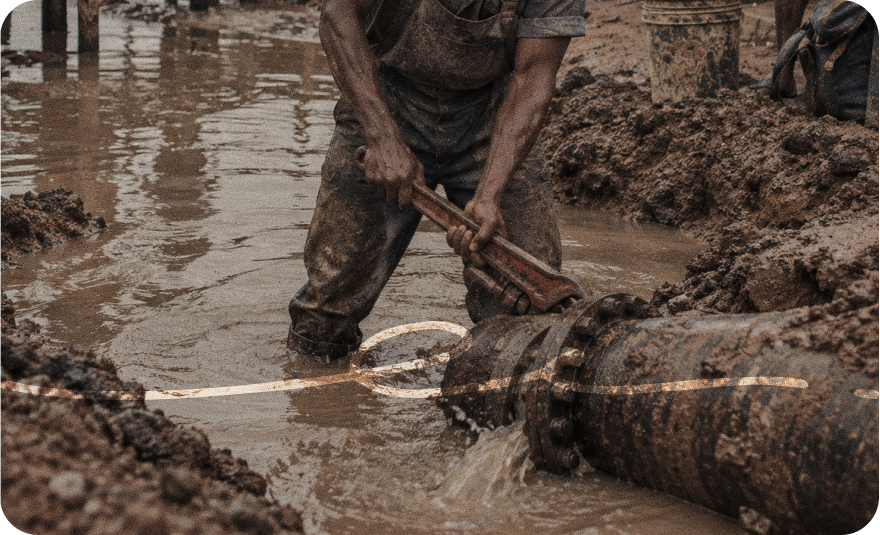
We had gotten used to the decay completely. Then one day, a young plumber with big dreams moved to the area. He had just graduated from a technical school and still had the innocent energy of someone who thought things should work the way they were supposed to. He saw the street that was flooded, the water that was moving, and the cars that were all over the place. He first thought about doing what the government hadn't done in almost a year. He waded into the muddy water up to his waist on Saturday morning with his heavy-duty tools. He then started to dig to find the broken valve that would stop the leak.
He believed that the people in the neighbourhood would back him up. He thought he would feel better. Instead, he was met with hostility. Wasiu and Chuks were the first to face him. They jumped into the water to push him away from the trench. "Are you nuts?" Wasiu yelled, his neck veins bulging. Do you want to take food away from us? Who sent you?
Baba Risi, the vulcaniser, joined in by throwing down his rags in protest and saying that the plumber was a government spy trying to ruin their businesses. Even the woman selling snacks yelled at him from the sidelines, asking if he would pay for her kids' school fees when the crossing was gone, and her business slowed down.
The young plumber stood in the muddy water with a heavy wrench in his hand, not knowing what to do. He looked around at the angry faces and realised, with a heavy heart, that the community didn't want the pipe fixed anymore. They had become so dependent on the broken pipe's economy that a permanent fix now felt like a direct threat to their lives.
We often wonder why it's so hard to make real changes in our country. We hold the elites, politicians, and colonial borders responsible. But maybe the uncomfortable truth is that we have made our problems into a business.
We have built many businesses, identities, and ways to stay alive around our broken systems, and we are afraid of what a working society might be like. We make money from the dark by selling generators, from fear by selling private guards, and from broken pipes by charging a toll. When survival turns into a business, the cure becomes the enemy. We are now a group of people standing knee-deep in mud, fighting with all our might against the one person who just wants to turn off the water.