
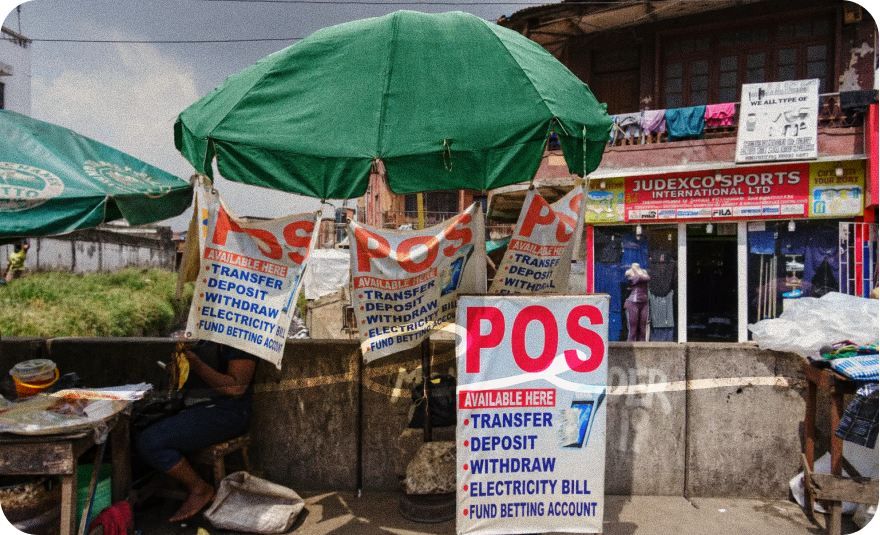
The green umbrella at the corner of the intersection didn't really protect anyone from the harsh afternoon sun, but to the six people who were standing under it, it was the most important place to be in the neighbourhood.
It was Friday, the last day of the month, and all of the commercial bank apps had decided to crash at the same time. The ATM galleries were empty, with screens that said: "Out of Service." Once again, cash had become a rare, mythical thing.
Mama Joy, a woman in her late forties, sat in the middle of the crisis on a plastic chair behind a small wooden table. A small, black Point-of-Sale (POS) terminal sat on the table. This was her tool of total control.
Tunde, the third person in the queue, looked at his phone for the fifth time. The network indicator was stuck at one bar, which was very bad. He needed 10,000 Naira to buy medicine for his daughter. It was meant to be a simple deal, but nothing is ever simple in a country where basic infrastructure is seen as a privilege rather than a right.
The man at the front of the queue begged, "Mama Joy." "Please, just give me five thousand." "I will send six thousand to your account."
Mama Joy didn't look up. She slowly counted a stack of limp, dirty Naira notes, licking her thumb with great care. She knew exactly what she possessed. She had the one thing that everyone on the street needed to get through the weekend: cash.
"The network is bad," she told the crowd, and her voice sounded like that of a head of state. "Withdrawing ten thousand now costs two thousand Naira. "Take it or leave it."
A loud groan came from everyone in the queue. Two thousand Naira was a tax of twenty per cent on their own money. It was extortion. Tunde's chest felt like it was going to burst with anger. "That's too much now, Mama Joy," he said. "It was two hundred Naira yesterday!"
Finally, she looked up, and her face showed no sympathy at all. She pointed to the bank building down the street that was empty. She said flatly, "Go fight the bank manager." "Step aside if you don't want it." People are waiting.
They all knew she was right. There was no alternative. Tunde saw the man in front of him angrily tap his PIN into the machine, pay the high fee, and leave with a small amount of cash. Tunde did the same thing when it was his turn. He put his pride aside, paid the ransom with his own money, and took the money.
Tunde realised something very uncomfortable about Nigeria as he walked away. We spend our days cursing the politicians. We curse the elites, governors, and ministers who keep the country's wealth to themselves.
But the scary truth is that the oppressor mindset doesn't stop at the doors of government buildings; it goes all the way down to the corners of the streets. We have accepted the corruption of our leaders as normal. As soon as a regular person gets a small advantage, like a little bit of power, a rare resource, or a working POS machine during a network crash, they use it against their neighbours.
We are not just victims of a broken system; too often, we choose to be part of it. We complain about the dictators at the top, but deep down, we want to be the next one to sit under the green umbrella.