
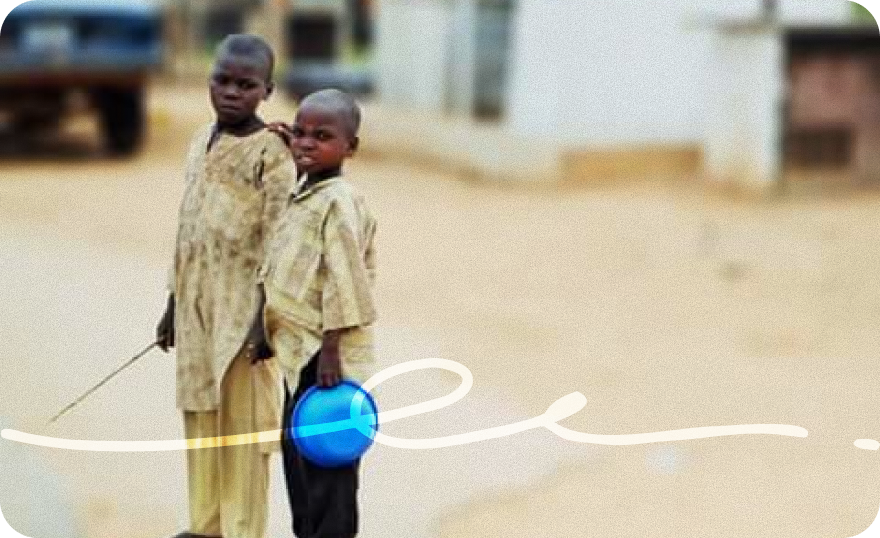
“Go away!”
“Dan Allah mallama, ina ji yunwa,” I said, emphasizing my hunger and need for help, no matter how small.
“Don't bother me, Dan iska. Abi na me born you? All these useless Almajiri,” she barked in response.
Hello, my name is Shehu, and I am an Almajiri.
I didn't choose this life; it chose me.
I was five when my father took me away from our home in Sokoto to an unknown place, which I later found out was Kontagora in Niger State. I was placed under the care of Mallam Bilyamin. What was originally an opportunity for me to learn more about Islam turned into the undoing of my life.
I did learn, but it wasn't the right thing. I only realize that now that I am older. I've been with Mallam Bilyamin for Eight years now, and in all those years, I have had to work so I could eat, begging for alms but never using the proceeds to nourish myself.
The rules were clear
Bring your proceeds back home after a day's work. When an opportunity to better yourself comes, make sure not to accept it.
What you are doing is the will of Allah; never stop. Never trust an infidel.
I mingled with the area boys in Tudun Wada and oftentimes engaged in conflicts with the Dadin Kowa boys. That was how I met Musa, my best friend. My background became a chore to remember as I grew older, but Musa still remembered his origin. He said he was ten when his father brought him to stay with his Mallam, and though he knew his way back home, he never wanted to return.
We were seated at the entrance of the Al-Azeez stores one Thursday evening, bowls in hand and no soles on our feet. The evening air was thick with the smell of suya and exhaust fumes, and the rough pavement still radiated the harsh heat of the afternoon sun against our calloused skin. Around us, the world moved on; shoppers stepping around our legs, the distant, chaotic blare of trailers and kabu kabu's, but we were largely invisible. It was in this noise that he told me the reason he never wanted to go back.
His father had three wives; his mother was the second, and he was the first son from his mother, with seven younger siblings. No, his father wasn't wealthy, but he was fertile: with 25 children in total and counting. Life was already hard, with no food or water, so he was very conversant with begging. His father was violent too. When he woke up one morning and bundled a good number of his children into the tipper of a truck to a destination no one knew or dared to ask about, Musa was already anticipating his turn. The next day he was sent off, and that is how he found himself in Kontagora under Mallam Yusuf.
We were still conversing when a big car drove into the premises. We immediately stood up and began begging. The driver said, ‘Yankuri,’ and chased us away, but the madam called out to us.
‘Kai! Kai! Ku zo.’
We immediately rushed back. She was visibly uncomfortable, and I couldn't blame her; we both smelled terrible. She asked why we were barefoot, and I looked at her like she had grown two heads. How were we supposed to have shoes when we were hungry and almost naked?
We didn't reply, so she went inside and brought us two pairs of rubber slippers. She also asked if we had eaten. When we told her we hadn't, she reached into her bag to hand us some snacks, but we instinctively stepped back, declining the food and requesting the equivalent in cash instead.
The shift in her demeanor was immediate. The polite, uncomfortable smile vanished, replaced by a heavy, profound stillness. Her hand hovered over the snacks as the realization hit her. She looked at our empty bowls, then back up at our faces, silently connecting the dots: our hunger was secondary to the fear of what awaited us at home if we returned empty-handed. Her shoulders sank. With trembling hands, she reached for her purse. "I know you have to give the money to your mallams," she whispered, her voice cracking slightly, "but please... take this food too. I need to know you actually ate something today." When she handed over the cash and the snacks, tears were spilling over her lower lashes. I wondered what had just happened….from visible discomfort to this profound show of empathy. I was entirely confused. We thanked her quietly and left.
After that encounter, I was never the same. I had never looked at an infidel with respect, but that all changed. I couldn't say the same for Musa; all he had to say about the woman was that she was not dressed as properly as a woman should be.
That night, lying on my mat in the dark, poorly ventilated room filled with the steady breathing of two dozen other boys, I pondered the encounter. I had never been treated like a human being, with so much sympathy, as I had been shown today. The driver's reaction was typical, so it didn't hurt. But the madam's reaction was a crack in my reality.
Never trust an infidel. That was the rule. Yet, an infidel had just seen the pain I went through daily and shed a tear for me. I stared at the peeling ceiling, wrestling with a terrifying contradiction: If this infidel could weep for my empty stomach, what did that make Mallam Bilyamin, the holy man who claimed to love me, yet sent me out into the harsh streets to starve for his own gain?
For the first time in Eight years, the rules didn't make sense anymore.