
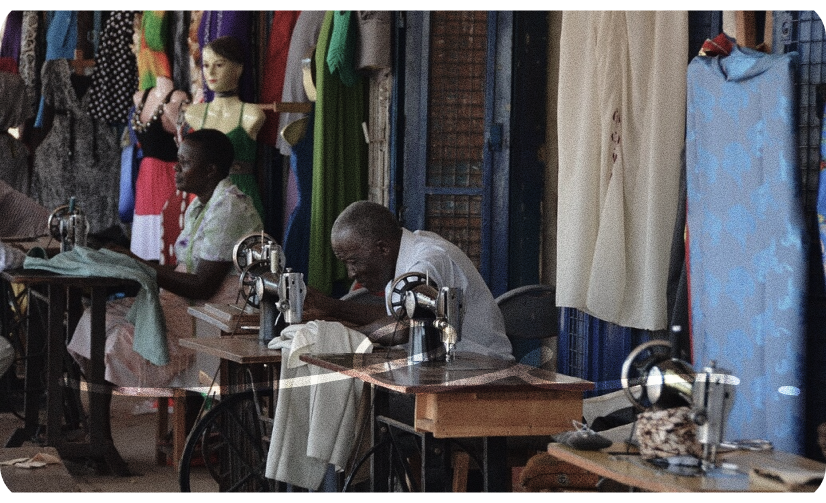
The heat of the morning is already being felt at the Ariaria International Market in Aba, Abia State, Nigeria. The sun chose to rise on this specific day, and it shone brightly from the eastern side of the sky. Traders are packed into the tiny passageways between stalls, setting up their merchandise for the day. Rolls of cloth are supported by wooden walls. Sewing machines may be heard in the distance. While a customer furiously disputes the cost of pants, a teenage apprentice drags a cart full of denim. At the center of it all is Chidi, a young dealer in his early twenties. He is opening the metal shutters of a tiny store that he has just lately started to call his own. Nothing about this situation appears in economic studies published by agencies such as the World Bank and the International Monetary Fund or in other formal business indices. Still, marketplaces like Ariaria, which is busy, spontaneous, and very human but also improvised and dane in nature because of its unique structural designs, are the basis of economic life for millions of Nigerians and Africans. To gain a deeper understanding of how this system functions, start with the everyday lives of people like Chidi. As part of the Igba-Boi, a commercial cultural heritage that has been around for hundreds of years, practiced by the Igbos, known as the apprentice system.
While his friends and peers are skimming universities' brochures or studying for standardized examinations, Chidi did not get paid, at least not in the traditional sense. Seven years back, Igba-Boi was more than just labor but an early-stage entrepreneurship incubator under the tutelage of a master-boy relationship. It functions more like an entrepreneurial scholarship program, where Chidi's education would be practical, demanding, and frequently draining. He slept on a mat behind the store, mopped floors, organized textiles, and watched his master haggle with clients from all across West Africa. He gained knowledge about the cognitive facets of human behavior, like when to give in to a persistent consumer, when to walk away, and how a brief delay may reveal a negotiating advantage. In a more informal sense, he was building what the famous French sociologist Pierre Bourdieu calls "social capital," which opens doors to economic opportunity through networks, reputation, and trust.
Money came from every interaction Chidi had and every gesture he could interpret. While Western economies use contracts and compensation to measure employment, the Igba-Boi approach evaluates development training and opportunities and knowledge and creates relational wealth, thereby helping the Eastern Society create its own institution when conventional institutions are inadequate.
Today, Chidi has developed into a reliable member of the market ecosystem and a proficient negotiator. His apprenticeship officially came to an end with settlement. The master provided Chidi his first product distribution, introduced him to important merchants, and occasionally even gave him a part of his store during a brief meeting. The most precious present, aside from the material goods, was the Master's public endorsement—a type of credit that no bank could offer. This is illogical for economists who are familiar with classical notions of why one would fund a competing business. Why offer capital to someone who may bargain with the same buyers while standing across the stall in the future? Ubuntu, an African ethical philosophy that is sometimes summed up as "individual success is inseparable from communal prosperity," contains the solution. Instead of undermining the network of communal commerce, Chidi's achievements reinforce it. New suppliers improve supply chains, draw in new clients, and increase awareness of "Aba Made" products. He now had a sort of and equipped with an unofficial venture capital that was financed by community, community mentoring, and community trust.
navigating life and the market with more drive and self-assurance. His invisible infrastructure consisted of every supplier who trusted him, every veteran trader who provided advice, and every client who came back for solid service. In street intelligence, interpersonal relationship networks are used to achieve accountability. Because developmental theories place a strong emphasis on formal institutions and quantifiable standards, they occasionally ignore this silent structure; however, in Ariaria, integrity and reputation frequently trump financial sheets and bank accounts. The Igbo apprenticeship program achieves a remarkable feat: it transforms social trust into financial prosperity. Dealers like Chidi stay operational and even make an effort to adapt when the state imposes new regulations. Informality is a resilient architecture and an alternate order, not an absence. Ignoring these structures runs the danger of destroying the same systems that support millions of people's livelihoods.
As dusk settles over Ariaria International Market, the little pathways are covered with lengthy shadows curated by the reflections of the settling sun, and the day's commotion gradually fades. Traders start closing their stalls. Apprentices brush the dirt off the tiny corridors and walkways. The constant buzz of sewing machines continues as a few workshops try to complete the day's final orders. Somewhere faraway, a youngster is getting ready to take the same route as Chidi did seven years ago, if not nearby. He will ultimately be turned over to a master, pick up the pace of the market, and be settled, carrying on a tradition that predates most developmental frameworks.
Chidi gently lowers and locks his shop. Tomorrow a.m., he will reopen it, exactly as his master did and as his own apprentice may one day do after him. From a distance, this market may look disorganized, a jumble of booths, bartering voices, and impromptu activity. But underneath the surface is a structure of trust, mentorship, and community investment referred to as "informal." That term seems strangely inadequate as I stand here in the dark. What occurs here is an order, one founded on connections, relationships, and rules, where individuals like Chidi are already benefitting from invisible systems of opportunity with the few resources they have: faith, resilience, and the resolve to create something where nothing was given. It is evident that communities frequently create their own institutions in the absence of established ones.