
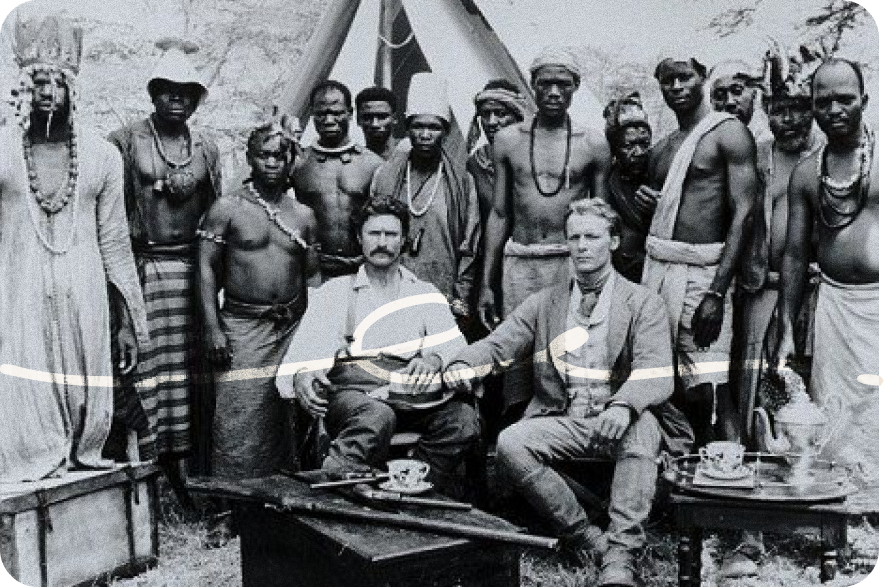
In discussions about the consequences of colonialism in Africa, popular mentions include economic exploitation and widespread underdevelopment that characterize the colonized nations. The continuous manipulation and control of the government in the colonies even post-independence is one of the ongoing aftermaths of colonization. However, there has been undue silence on the psychological orientations and the sociological structures engraved in the mind by the colonial system. These have more lasting effects on the people even long after independence. They set the tone for the operation of the country and the attitude and sentiments of the people.
The British never sought to build a blossoming nation; Nigeria was a source of economic prosperity for them. The amalgamation of the northern and southern protectorates in 1914 was merely for administrative convenience. In other words, the amalgamation was to make it more convenient for them to extract more resources from the geographical location called Nigeria for their own economic prosperity. This amalgamation merged over 250 vastly different tribal groups into one nation for economic gain. The colonial power ruled in a way that eroded the sense of belonging in Nigerians. When the sole purpose of the leadership in a society is self-aggrandizement instead of the welfare of the people, the people learn to fend for themselves. They are left with making for themselves the life that their leaders neglect to give them. Hence, the British created a low-trust society where no one trusts the next man. They created a survival-oriented society, where everyone is out to get everything for themselves. This mindset is a part and parcel of the Nigerian society to date.
The British ruled Nigeria through the system of indirect rule. It appointed colonial administrators who were above traditional rulers, or warrant chiefs in smaller villages and where there was no major traditional ruler. The British also usurped some traditional rulers who were unwilling to cooperate and replaced them with warrant chiefs. The traditional rulers and warrant chiefs were required to rule according to the whims and caprices of the British government. The social implication of this is that it sets the pattern for a kind of political leadership in Nigeria, where leadership is exercised on a people, rather than on their behalf. Leadership is seen as a coercive, exploitative use of power that must be applied in using state resources to accomplish the objectives of the ruler, with the leader having no accountability whatsoever to the citizens over which they rule. This style of leadership is basically the order of the day in Nigeria’s political climate till today.
The strong ethnic division in Nigeria’s politics today is by design. The British lumped up over 250 vastly different tribes without any shred of collective consciousness of belonging as a nation. The divide and rule tactic of the colonial power, which had different administrative systems for the southern and northern parts, also contributes to the nonexistent ethnic unity in Nigeria. The British handed over an ethnically divided nation, and it has been the order of the day since independence in 1960. Every Nigerian innately identifies with their tribal group over and above their identity as Nigerians. ‘Nigerian’ is only an official identification, not an identity etched in anybody’s mind.
The British colonial government established and managed the country as a means to extract resources for the British government, rather than as a leadership to create social welfare and economic prosperity for the people. This means political leadership exists to scoop as much as it can from the nation and its people to achieve its own goals. Government institutions, hence, are seen as anti-people. Government agencies and institutions today seek to extract as much as possible from the citizens in taxes, levies, and various unfounded surcharges. State resources are utilized to enrich the men in power. The result of this is that citizens also seek to extract from the state, or at least stop the state from taking from them. Hence, corruption. Public institutions and resources do not belong to anybody. The consciousness of leaders in government is to take from state resources, while the citizens protect their resources from the government. This consciousness stems from the British style of ruling during the colonial years. The Nigerian greed was designed by the British with their style of leadership.
The British also ensured that in addition to the indiscriminate extraction of resources from the colony, the colonies were made to use British goods, purchased at exorbitant prices, further exploiting the people of their resources. British goods became only the privilege of the rich. Nigerians today still have this mentality that foreign goods and commodities have better quality than domestic ones. This cultural inferiority spans across every aspect of life in Nigeria, from fashion to food and even education. Foreign-sourced commodities are more preferred than what is available locally, even though they are more expensive.
The damage done to the Nigerian minds and society cannot be undone in 4 or even 8 years. There have to be policy reforms, laws, and enforcement for the same over decades to undo these social maladies. These, admittedly, cannot be achieved in Nigeria without coercion. Indeed, coercion is necessary to change a way of life that has been ‘working’ in a country for almost 7 decades now. The question now is whether this change is feasible with the current system of democracy and federal system of a government in Nigeria. I think not.