
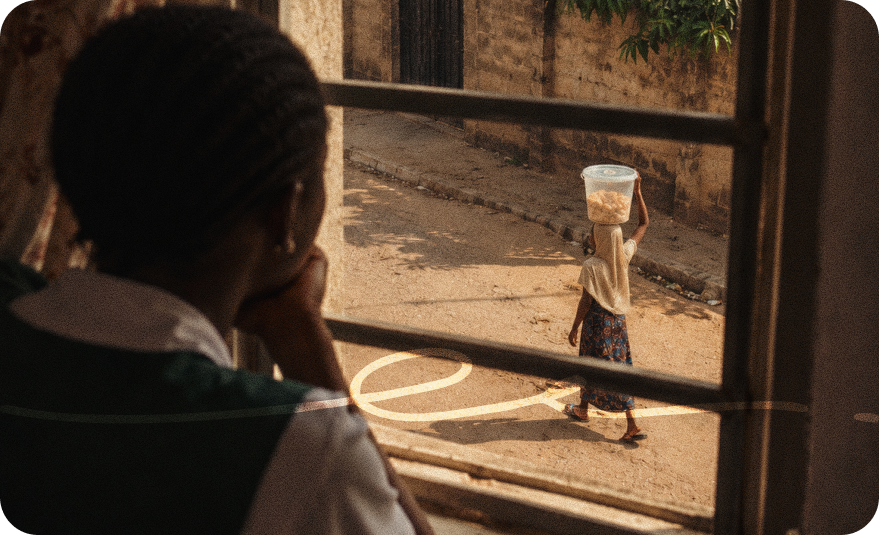
Every morning for the six months since my family moved into a two-storey apartment in Samaru, I would look out the window of my room and see a woman frying masa. By the time I was dressed for school in my perfectly ironed green-and-white checkered shirt and three-quarter green skirt, I would see a young girl, most likely a teenager like myself. She wore a hijab that I presumed was once white but had lost its color from countless washing cycles, balancing a transparent bucket filled with masa perfectly atop her head.
We took the same route out of the street. While I walked to the bus stop, she went about selling her masa.
The day I finally spoke to her, after months of lingering stares, brief locked eyes, and tentative but intentional good mornings, she paused near my bus stop a few seconds longer than usual.
I said hello to her and introduced myself. She wasn't fluent in English, but she understood me. She spoke a mixture of Hausa and Pidgin English and told me her name was Fauziyya.
I took a good look at her, up close. She had full brows, beautiful tired brown eyes, a perfectly carved button nose, and full, round lips. Her skin was the darkest shade of brown I had ever seen. It glistened in the morning light, carrying the faint scent of shea butter.
She told me she loved my uniform and my shoes. Before I could say much else, the school bus screeched to a halt, its blaring horn shattering the quiet moment. It prompted me to hurry toward the open doors, waving a quick goodbye to Fauziyya over my shoulder.
That morning marked the beginning of a friendship I never knew I needed.
Soon, it became a routine. We met on the same route that led to our different destinations, and we talked about ourselves, our lives, our dreams, and our realities.
While I had everything planned out for me: finish school, build a career, and live entirely on my own terms, Fauziyya's reality was a striking contrast. There was no such plan. It was simply to live each day as it came, wake up early, and assist Umma in selling masa.
The evening of my sixteenth birthday, long after the noise of the celebrations had settled, I realized the day wouldn't feel complete until I shared it. I carefully wrapped a slice of cake and went to find Fauziyya. Until then, our friendship had existed only on the street, but this was my very first time stepping into her yard. I waited as her mother called her out for me, and together, we retreated from the open compound to sit in the quiet shade of a large cashew tree.
I handed the cake to her, and the delight in her eyes was palpable. She took a bite and smiled before a sudden wave of sadness settled over her face. I asked her what was wrong. After a long minute of silence, she told me she had become a woman the night before. She never knew what her actual age was, but it was obvious that I was older than she was.
She went on to explain that her time in her father's house was now numbered. She would soon be given away in marriage, aure, just like her elder sisters and cousins before her. I couldn't understand it; to me, she was still just a child. I voiced this aloud, and she looked up at me. It was only then that I realized her face was streaked with tears. Gently holding her chin, I wiped one away with my thumb. When I asked her if she even wanted to get married, she told me she didn't have the privilege of choice. Her only hope was that whoever they gave her to would be kind.
Weeks later, exactly as Fauziyya had envisaged, loud music and merriment erupted from her yard. Standing at my window, I looked down and saw her dressed in a beautiful flower-patterned Ankara gown and a yellow lace veil. A man I didn't recognize lifted her up and placed her onto the back of a motorcycle. As the rider zoomed off into the distance, the crowd left behind in the yard shouted in excitement.
The next day, I walked out of our compound in my uniform and looked toward Fauziyya's yard. It was quiet now, and a deep sadness washed over me. I grieved the loss of my friend, but more than that, I grieved the fact that she never got the chance to live life on her own terms.
She spent her childhood hawking in the sun and held onto dreams that were always kept too far out of reach. Now, at such a tender age, she had been given away to a man she didn't know, expected to live in his house and bear his children.
As I stood staring at the empty yard, I couldn't help wondering how many other girls disappeared from childhood in the same way Fauziyya had.
There are many others like her, trapped in a cycle that passes from one generation to the next.
I miss my unusual friend.
I constantly wonder how she is doing.
Wherever she is today, I can only hope she found the kindness she prayed for.