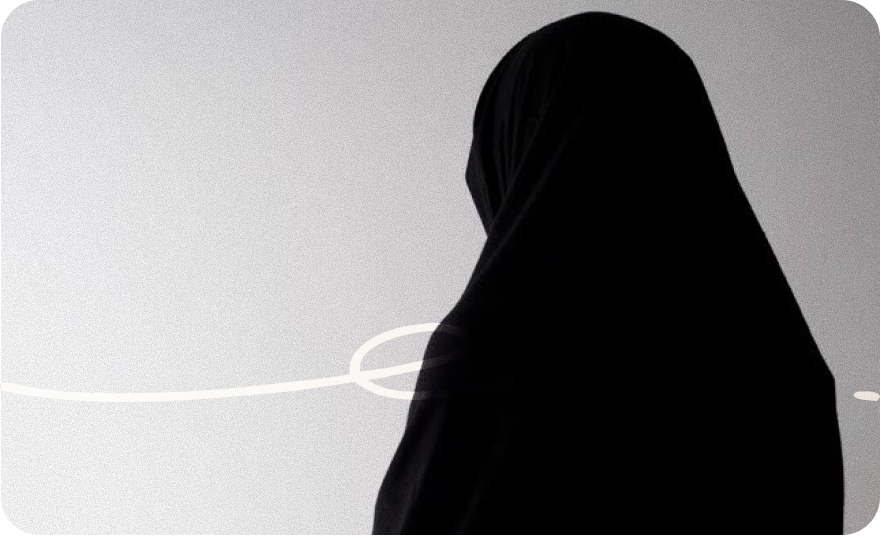
I understood what conviction in faith looked like the day Ummu refused to lift her niqab at gunpoint.
I was eleven years old. We had just finished walking through the bustling streets of Obio/Akpor Market in Port Harcourt and were headed towards Mrs. Okeke's shop on the outskirts of the market when a policeman, reeking of beer and cigarette smoke, stopped us. Without provocation, he demanded that she lift her niqab so he could see her face. Ummu politely declined, explaining that covering her face was a matter of religious principle. But her explanation wasn't good enough for the policeman. He called her an ojuju, demanded to know what she was hiding, and before I could process what was happening, had already cocked his gun. In a hoarse voice, he shouted at Ummu to lift her veil.
While I trembled, Ummu remained calm. She looked him straight in the eye and simply said,
"I will not lift my niqab."
Then she continued walking, holding my left wrist.
"I am talking to you!" the policeman yelled after us.
Ummu told me to calm down and kept walking.
He trailed us.
By the time we reached Mrs. Okeke's shop, passersby had already begun to stare, wondering why a policeman was shouting after us. Mrs. Okeke asked what had happened, and as my mother explained, she turned to the policeman and spoke to him in Igbo. I assumed she was trying to establish some familiarity before asking if he had never seen Muslim women dressed like this before.
"Abi you wan talk say you no know say people wey de like this de?" she asked.
He shrugged, as though he hadn't just harassed two people. He replied that he wasn't serious; he had only been threatening my mother and had never intended to shoot.
A threat?
After he left, I looked at Ummu, expecting relief. Anger. Anything to validate the fear that still gripped me. Instead, she looked as though nothing extraordinary had happened. She laughed with Mrs. Okeke, continued her shopping, and carried on with her day.
At eleven years old, I wondered if I had overreacted. Looking back now, I realize that what unsettled me wasn't just the gun. It was how casually another person's religious decision could become grounds for intimidation.
As I grew older, I learned that the stereotypes surrounding the hijab and niqab ranged from ignorant to dangerous. Sometimes, the ignorance wasn't armed with a gun, but with the hypocrisy of our own neighbours.
One afternoon, Ummu and I were walking home after visiting a relative. As we passed a church in our neighbourhood, a group of children began chanting,
"Ojuju... Ojuju... Ojuju..."
When their father realised what was happening, he was furious. He immediately reprimanded them and later brought them to our house to apologise to my father, Alhaji, and Ummu.
I admired him. Here was a father correcting his children instead of excusing them. He made the children apologise. But as he turned to leave, he muttered under his breath,
"Make this children no go make religious war start."
I assumed Ummu and Alhaji hadn't heard him because they smiled and bade him farewell. But they had. Ummu's remark after he left confirmed it, Alhaji simply said,
"You can't blame him. Just ignore."
But I didn't.
I didn't ignore.
I said nothing. But I remember thinking that his concern wasn't that his children had insulted us. It was that they might insult the wrong people and cause trouble. His apology wasn't rooted in understanding; it was rooted in fear.
Overtime, the assumptions only multiplied, a long catalogue of boxes people fitted me into simply because I chose to dress in accordance with my faith.
Some assumed I was uneducated because I wore a hijab. Others dismissed me as self-righteous because I dressed differently from many of the Muslim women around me. More times than I can count, strangers called me "Hajiya" simply because I was walking beside an older man - my father - assuming I was his wife when I was clearly still a child. At other times, people assumed I was Hausa or could speak the language simply because I wore a hijab.
What has hurt me most through all these encounters is the ease with which my faith is equated with something frightening - ojuju. Even when said as a joke, the word has always carried mockery.
I had hoped that, with time, the word would lose its power.
It didn't.
Years later, it still found new people to haunt.
In July 2026, a young girl from Ilorin, Kwara State, represented Nigeria at the Spelling Bee World Cup in Shanghai, China, alongside three other students. They returned home with a gold award. She couldn't have been more than fourteen years old. Dressed in her hijab and niqab, she spoke with confidence and spelled with remarkable precision. Her intelligence and composure should have been the focus. Instead, much of the online conversation centred on how she looked. A news outlet even altered the competition photographs to reveal her face without her consent. Photos of her circulated widely, and in the comments section came the familiar insult.
Ojuju.
The same word that followed my mother years earlier. The same word children once hurled at us on our way home. Different generations. Different women. Same prejudice.
Still, whenever I think about faith, I do not remember the insults first.
I remember Ummu's words.
"I will not lift my niqab."
Long before I understood prejudice, I watched my mother teach me conviction. And now, despite every stereotype thrown my way, that lesson remains strongest.