
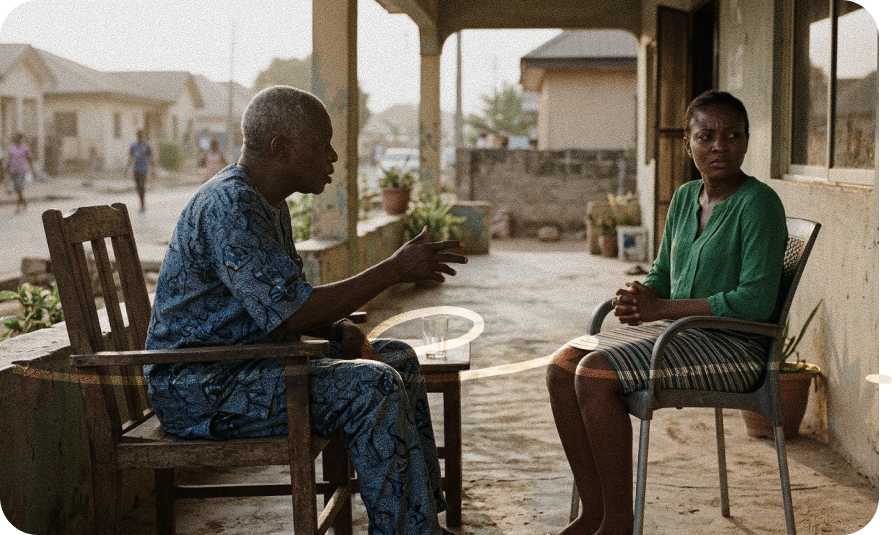
"Come back home. There is enough room in the house. I have a shop for you to keep your machine. There is water heater, bath tub. Whatever you need," my father said on the phone.
"Okay, Daddy."
It took about two weeks to finalise the arrangements. The house was about a twenty-five-minute drive from my place in Uyo, in a village where everywhere was quieter. My father had built it about seven years earlier and chosen a burnt-orange colour for the huge gate. The compound was big enough to contain a car. On the verandah were chairs and a table for entertaining visitors.
Inside were three rooms, each with its own bathroom. The dining area was big enough to pass for another room. I liked the white-and-black patterned tiles in the living room and dining area against the nude and brown paint on the walls.
My mother used to complain about the house.
"See how small my kitchen is and yet so much space is wasting in this house. What is this huge corridor for?"
When I arrived, I remembered her words and smiled. The kitchen was so small it could barely accommodate more than three people.
I dropped my things in my room and went to the living room. The last time I had been in the house was four years earlier, for my mother's burial.
There was a recent portrait of my father and an older one of him in his army uniform. He used to tell us stories about fighting in the Biafran War. Beside his portraits was a photograph of my mother, perhaps in her late twenties. She looked so young.
"Mummy, I miss you so much," I whispered, touching her portrait.
I went into the kitchen and saw the dirty dishes in the sink. Then I went to my mother's room. Her things were still there, untouched.
The only sound in the house was my father's radio.
I picked up an old photo album. When we were children, my siblings and I brought out the albums whenever guests visited. We sat with them and explained the photographs: where we had gone, why someone had a particular expression on their face, or why a family member wasn't in a picture.
One photograph showed my mother, my sister, Aunty Ogechi, our neighbour, and me at the beach when we lived in Lagos. My sister and I were crying. Aunty Ogechi was laughing, while my mother had a big frown on her face, her mouth open as though she were saying "oooooo".
Aunty Ogechi had suggested that we enter the water and take pictures.
"Abeg make water no carry my pikin o," my mother had said.
"We no go enter the deep part," Aunty Ogechi replied.
A big wave came while the photograph was being taken. I laughed at the picture before closing the album.
I returned to my room and arranged my things in the wardrobe. Then I picked up a broom and started tidying the house. Only one neighbour, a tenant, had come to welcome me. Since my mother died, nobody had come to stay over. My sister had moved to Lagos, leaving my father and younger brother in the house.
For the first few weeks, my father called me to the verandah to sit with him. He tried to talk about personal issues I was dealing with at the time. I gave one-word answers and shifted in my seat. We had never really talked that way when I was growing up.
Sometimes, he got angry with my younger brother because he felt we hadn't served him food on time. My brother would sometimes be in my room using my Wi-Fi when my father came to my door and banged hard on it with his hand.
"What you people are doing to me, your children will do to you too," he would say.
At first, I stayed quiet inside.
I cleaned the house, cooked, pressed my phone, and sometimes sewed clothes for clients. One day, my father asked, "These people you sew for, why have they never come here?"
"This place is far. I will deliver the clothes to them myself," I replied.
He would keep quiet, but sometimes, around one in the morning, he would sit outside and nag. He asked what sort of clothes I sewed that made my clients unwilling to come to the house. Then he would bring up things that had happened in 1985, issues that had been resolved years earlier.
I remembered my mother saying, "Your father can never let go of the past. At least he should let me sleep and go outside and talk."
As a child, I hadn't understood what she meant. Now, I could hear my father from my room. Sometimes I put on my earbuds and listened to music.
Other nights, he would wake up and sing spiritual warfare songs loudly. One of them was "Satan don fall for gutter. Match am match am." He stamped his feet hard whenever he got to "match am."
I remembered my mother complaining about the same thing when she was alive. As a child, I had wondered why she couldn't just sleep and let him be.
I don't remember exactly when we started insulting each other. I tried to be patient. Eventually, when he called me a useless child, I began calling him a useless father.
Our arguments became more frequent, and sometimes he called my uncles to intervene. At first, I explained my side of the story and cried while doing so. My uncles would listen and say, "Children obey your parents in the Lord."
At the end, I was still the one being asked to kneel and apologise to my father.
Eventually, when my uncles came and asked what I had to say, I replied, "Uncle, I have nothing to say."
Sometimes my father locked me out of the house. I sat outside until my younger brother returned with his spare key. Other times, my father threatened to sell my sewing machine.
"That machine, I was the one that bought it for your mother. It is mine and I will sell it."
At first, after an argument, I would call him and sit with him to talk about what had happened. As the arguments became more frequent, I stopped.
There were peaceful days, too. My father would sometimes call me and give me a little money, telling me to buy body cream or make my hair. I was grateful.
Eventually, I stopped cooking and cleaning. My father complained about the state of the house.
"Children are in this house but the house is like animal house."
"This house is like Sahara desert," he said another time.
I said nothing.
One time, he said, "Because you can't take care of a home, that's why that man used to beat you up."
I didn't answer right away.
"No," I said finally. "He beat me up because of karma. The same way you used to beat Mummy up."
My father said nothing. Then he picked up his radio and threw it at me. It missed.
I left the living room.
"I will kill you in this house if you don't leave my house. You did not give me stone or gravel when I built it," my father said.
He began walking around the house with a machete. I decided it was time to leave.
I started looking for houses online and eventually found one. It was expensive. I would have to sacrifice all the money in my account to move out.
I arranged everything without telling my father. I planned to leave on a Sunday morning, when he would probably be at church.
I left as planned.
Living in my father's house saved me money on rent and electricity. Sometimes, there was food, too. I wished things were different.
My father had told me there was enough room for me. He hadn't been wrong about the room.