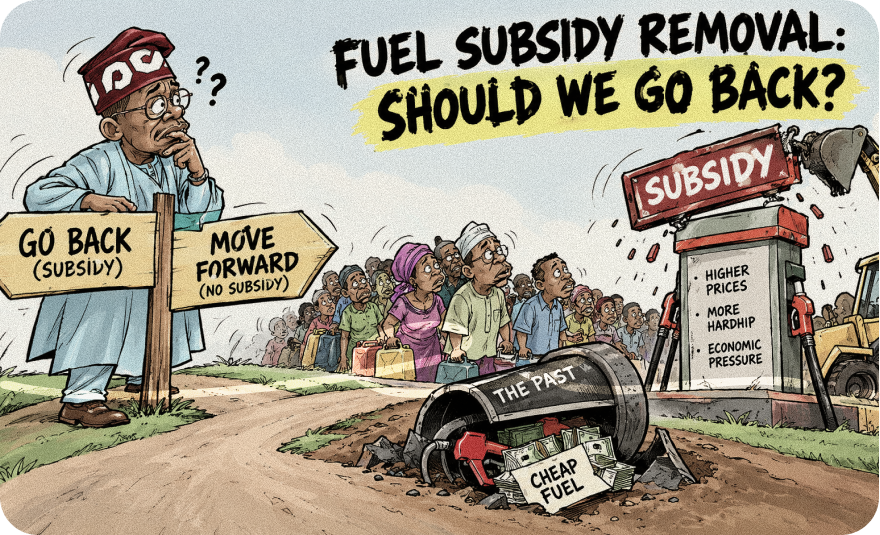
When President Bola Tinubu stood at the podium on his inauguration day in May 2023 and said the subsidy was gone, he set off a chain of events that has defined his presidency more than any other single decision. Petrol prices jumped overnight. Transport fares followed. Food prices climbed on the back of both. For millions of Nigerians, the subsidy removal was not a policy line item, it was the moment their monthly budget stopped making sense.
Three years on, the numbers tell a more complicated story than either camp wants to admit, and the reform case deserves to be made in full before it is weighed against its costs. The Federal Government says subsidy and forex reforms mobilised roughly N15.8 trillion in resources for the federation between June 2023 and December 2025, with N5.4 trillion going to Abuja and N10.4 trillion flowing to states and local governments. That is not an abstract fiscal figure. President Tinubu himself told visiting Oyo traditional rulers in July that states are now receiving four to five times what they used to collect monthly from FAAC. Before 2023, most states could not meet salary and pension obligations without borrowing, and several ran up years of arrears doing it. That era has not vanished everywhere, but the room to escape it has genuinely opened. Here in Akwa Ibom, Governor Umo Eno's administration has paid out N81.06 billion in pensions and gratuities in three years, more than the N70.07 billion the previous administration paid across its final four years combined, according to a review of the state's own audited accounts. That is not spin. Retirees who spent years chasing arrears are being paid, and that would have been much harder to fund out of a treasury still bleeding trillions into subsidy every year.
The same increase in fiscal space, though, has produced its own warning sign. Tinubu has had to publicly caution governors against pouring their newly enlarged allocations into flyovers and other prestige projects in low-traffic areas rather than the roads, healthcare and security infrastructure that would actually reach ordinary people. That the president felt the need to say this out loud, and that opposition figures like Peter Obi have echoed it while also turning it back on the federal government's own unfinished megaprojects, is itself evidence that more revenue does not automatically become better governance. The subsidy savings created the opportunity. What states and the federal government do with it is a separate test, one the reform's gains do not by themselves pass.
But the Finance Minister, Taiwo Oyedele, has also been unusually candid about the other side of the ledger. He admitted the government's own wage bill, N9.39 trillion in adjustments and minimum wage increases, exceeded the entire federal share of subsidy savings. Petrol that sold for about N185 a litre before the reform now trades between N1,100 and N1,400. The Monetary Policy Rate has climbed from 18.5 percent to 26.5 percent. Food inflation has eased from a punishing 24.82 percent to 17.52 percent, movement in the right direction, but still a rate that keeps millions of households one bad month away from real hunger. Oyedele's own words were direct: these are major, felt costs, and he would not stand there and pretend otherwise.
Into this contested picture steps Atiku Abubakar, now flying the ADC flag for 2027, and his pitch deserves more care than the "he wants subsidy back" headline suggests. What Atiku has actually unveiled is not a return to the old import-subsidy regime. His Atiku Economic Recovery Plan proposes a capped, audited production subsidy tied to domestic refineries, crude supplied at a preferential price only to refiners who can prove they are turning it into Nigerian fuel at Nigerian pumps, with reconciliation from allocation through delivery, sunset clauses, and eligibility open to any qualifying refinery rather than a politically favoured few. He has also pointed to something the government has not adequately explained: NNPCL's own audited accounts recorded close to N4.84 trillion in Energy Security Expenses in 2023 and N7.13 trillion in 2024, figures that look, on their face, a lot like subsidy under a different accounting label. If the government can absorb differences between the market cost of fuel and what it recovers at the pump without calling it subsidy, Atiku's question about what actually changed at Eagle Square is a fair one.
I voted for Atiku in 2023. On the substance of what he has now proposed, I still think he is wrong to build his campaign around this, and I will not pretend otherwise to protect old loyalties.
The AERP is a more disciplined document than the subsidy Nigeria buried in 2023, and it is honest about something the old regime never was: it names its cost upfront rather than letting it balloon in the dark. That is worth crediting. But the honesty of a bill does not make it affordable, and a subsidy that is well designed is still a subsidy, a standing government commitment to hold a price below its market cost, funded either by revenue the country does not reliably have or by more borrowing. Nigeria has already taken on N11.9 trillion in fresh debt since the reforms began, according to the Finance Ministry's own scorecard. A new subsidy programme, however tightly ring-fenced on paper, adds another line to a budget that is already straining under debt service, and sunset clauses on subsidies have a long history in Nigeria of outliving their own deadlines once refiners, marketers and the political constituencies around them have an interest in keeping the tap open.
There is also a harder question the AERP does not fully answer: why route support through crude allocation and refinery compliance monitoring at all, when that is precisely the machinery that made the old subsidy so easy to game. Reconciling barrels from allocation to pump, auditing refinery yields, verifying that benefit is passed to consumers rather than pocketed, these are the same enforcement tasks Nigeria's regulators failed at for over a decade under the old regime. A better spreadsheet does not fix a governance capacity problem. Meanwhile, the government's own admissions cut against its confidence too. Oyedele has conceded that the wage bill alone outran the entire federal share of subsidy savings, and that food inflation, while easing, remains high enough to keep households under real strain. The fair criticism of Tinubu's government is not that it removed the subsidy. It is that it has been slow and defensive in accounting for where the savings went, exactly the gap Atiku's Eagle Square line is aimed at, and it has not moved fast enough to turn fiscal space into jobs, functioning small businesses, and a naira that holds its value.
That is the middle ground worth standing on. Not a new subsidy architecture, however carefully audited, and not a defense of reform for reform's sake either. What this moment calls for is a government that publishes the accounting Atiku is demanding, on Energy Security Expenses and everything else, and spends what remains on productive capacity rather than recurrent costs alone. It also calls for an opposition willing to test whether Nigeria's institutions can actually run a disciplined subsidy before asking the country to fund one again. Nigerians did not ask to be tested this hard. But the test does not get easier by rebuilding, even carefully, an instrument that failed us for over a decade. It gets easier when leaders, in government and out of it, stop treating subsidy as either sin or salvation and start treating job creation as the actual work.
Should we go back? No. We should go forward, carefully, and honestly, with the receipts finally on the table.