
The first thing I do when I enter a new house is check the bathroom.
I don't know when I started doing this.
Maybe it was because, growing up, the bathroom was never really mine. Someone was always inside it. Someone was knocking. Someone was shouting your name from the passage because they had been waiting too long. Sometimes you had to brush your teeth outside, with one foot on the concrete and your eyes on the tap, while somebody argued in the next room.
So when I moved in with him, I checked the bathroom first.
There was a mirror above the sink and enough space to stand in front of it without pressing yourself against the wall. I remember thinking that was luxurious.
He laughed when I told him.
“You and your village things.”
I laughed too.
There were many things I liked about that house.
I liked that I could leave my cream on the sink and find it there later. I liked that nobody would knock on the door while I was bathing unless it was him. I liked waking up and finding him already in the kitchen.
He made breakfast for me before going to work. Sometimes he woke up as early as six to cook, even though I stayed home most days and did very little. When I had morning lectures, he sometimes dropped me off at school. He helped me with assignments and term papers, researching and writing them for me. All I had to do was attend classes and write my examinations.
I didn't do laundry either. I only handled the cooking.
I remember a conversation with a friend who was complaining about how exhausting it was to keep up with housework and laundry.
“Well, I can't relate,” I told her.
“You can't?”
“No. I don't do laundry. I only handle cooking.”
“So who washes your clothes?”
“He does.”
“Jesus. You're lucky o. My husband will heap clothes for me to come back and wash.”
I laughed. My mother liked him, too. She would say, “He's a good man.” She was surprised that he did housework while I did almost nothing.
We had our own jokes. We noticed the same silly things about people. Once, we saw a man walking in a way that reminded us of a cultural dance, and we laughed about it. Another time, a man who had spent two years in prison for robbery came out looking so lean that we started calling him leke-leke, after the bird.
“Someone came to fetch water in the compound today,” one of us would say.
“Who?”
“Leke-leke.”
And we would laugh.
Sometimes I think that was part of what made us close. We could look at the same ordinary thing and find it funny without having to explain why.
When I was sick and couldn't take care of myself, he bathed me. If I vomited, he cleaned the floor and cleaned me up. He bought me clothes, jewellery, wigs and phones. Sometimes I told him what I wanted; other times, he surprised me.
During COVID, when his business was on hold, I lost my phone. He emptied his account to buy me another one so I could watch sewing tutorials on YouTube.
The shop attendant looked at me and said, “You're so lucky. This man loves you. To buy phone at this period is not beans.”
I believed her.
There were times when he shoved me during an argument. Little shoves here and there, I told myself. I overlooked them. I don't remember the first time he hit me or left a mark on my body. It happened so many times that some of the incidents have become difficult to separate from one another.
I learned what to say when people asked about the marks.
I had fallen.
I had had a little accident.
Once, he hit my face with a door, and my head swelled. Before I left for fashion academy, he apologised, and we made up. I went to class as usual.
My tutor looked at my face.
“What happened to your face?”
“I had a little accident.”
“Car accident?”
“No. I mistakenly fell in the bathroom.”
“Eeyah. So sorry.”
That was the end of the conversation.
When I returned home, I talked and joked with him as usual. His apology hadn't settled anything inside me, but I behaved as though everything was fine.
Sometimes our arguments began with insults.
“You're a bastard,” he would say.
“It's your mother that is a bastard,” I would reply.
“What did you say about my mother?”
Then he would slap me.
Afterward, he would apologise and say he didn't know what had come over him. He would tell me I should learn to control my mouth.
I began to pay attention to his moods. Sometimes it was better not to answer him. I tried to avoid the things that made him angry, although I could never be certain that I had avoided enough.
There were nights when he would try to make love to me after he had beaten me.
I would let him.
His hands felt like cacti against my skin. I knew how prickly they were because my mother used to grow them when I was a child.
I would lie there and moan loudly.
That was something I had learned to do somewhere along the way—to make the right sounds, to give the body the evidence of pleasure even when the rest of me wanted to be somewhere else.
Sometimes I wondered if he could tell.
I don't think he did.
Or perhaps he didn't want to.
I started telling people about the things he did to me. It upset me that people could look at him and see a good man, that they could tell me how lucky I was while I was trying to find a way to live with what happened when we were alone.
He found out I was talking about our problems.
“Why do you tell people about the issues we have?”
“Why shouldn't I tell them?”
“Couples fight.”
“No. We're not fighting. You're beating me.”
I was scared of him. I wanted to leave, but I didn't have the money to rent a place or support myself. I wasn't working. I didn't know how I would pay for a house, feed myself or provide for a child if I left. I was also afraid that he would want nothing to do with the baby if I left, that he would use her to punish me.
Sometimes, when we fought, he would stop providing for the baby.
One day, I asked him for money to buy diapers.
“Please do not let whatever issue we have affect the baby.”
“You should have thought of that before acting foolish.”
“Please, she needs her diapers. The last one has been used up.”
“That is your business.”
I messaged a friend and asked her for money to get something. She sent me ₦5,000.
I bought plenty of diapers.
Then I hid them.
I kept them somewhere he wouldn't find them, so that whenever he refused to provide for the baby, I could take some out. I didn't want him to know I had them. I didn't want him to find them.
He never did.
We were arguing while I was in the bathroom. He slammed my back against the mirror, and it cracked. Then he threw me to the floor and kicked me repeatedly until I found it hard to breathe.
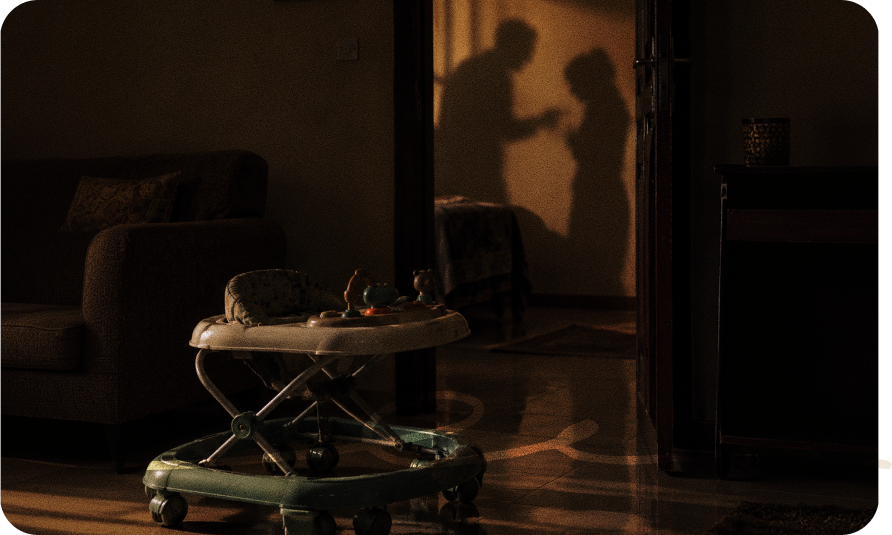
My baby was in her walker in the corridor. She watched me, then started crying.
My body was covered in blood. I had to limp over to her, pick her up and breastfeed her.
“Sorry, mama,” I said.
I don't remember how long I stayed in that house after that. I knew I needed help.
I called my father and cried.
I don't remember every word I said to him. I remember crying.
“Come back home. There is enough room in the house. I have a shop for you to keep your machine. There is water heater, bath tub. Whatever you need,” my father said on the phone.