
The highway, at least, offers the excuse of velocity and sprawl. Institutional decay does not require a long interstate road to manifest its malice; it is equally at home under the streetlights of our state capitals, where the state performs the theatre of readiness without any of its substance.
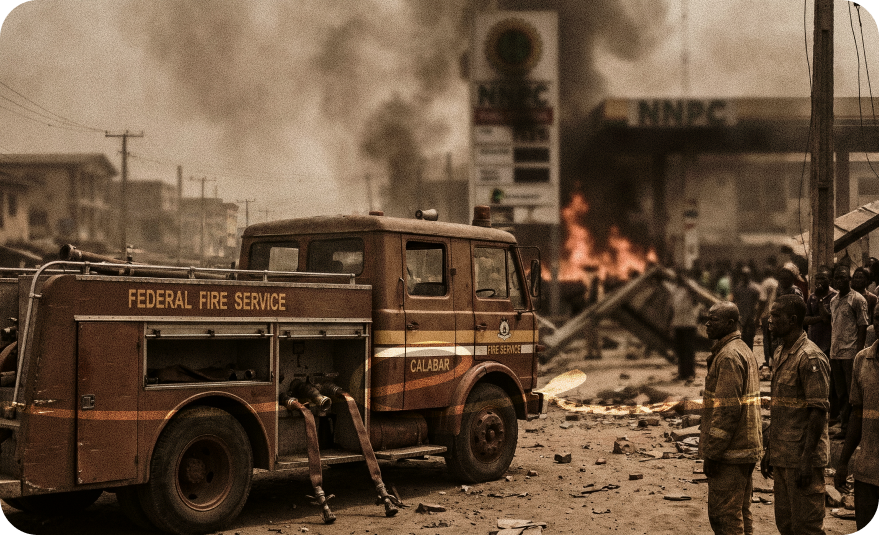
Consider what happened recently in Calabar, at a gas station swallowed by a sudden, violent fire outbreak. This was not a silent signal sent from a speeding vehicle on a dark expressway. This was a loud, highly visible public emergency in an urban center, witnessed by hundreds. The calls to the emergency line went out early and were dispatched to the fire service. The information was precise. The response, however, read like a dark comedy written by an indifferent bureaucrat.
First came the excuse that the fire truck had no diesel. Then came the excuse of water; the truck had no water. When a vehicle was finally mobilised and rattled to the scene of the blaze, the final, devastating punchline arrived—it had no hose.
There is a specific kind of violence in watching a fire truck arrive at a burning gas station without a hose. It is the visual representation of an empty shell, the appearance of an institution stripped of every function that justifies its existence. The men in uniform are present, the rotating lights are flashing, the budget for the department has certainly been signed off, but the actual capacity to save lives has been completely hollowed out.
And then comes the final act of the state ritual, the gubernatorial visit.
The Governor arrived to visit the victims in the hospital. The cameras clicked. Deep condolences were issued. The standard, focus-grouped promises of “looking into the matter” were read from prepared notes. Then the convoy drove away, and nothing else was recorded. No structural reform of the fire service. No accountability for empty fuel tanks. No inquiry into how an entire emergency response unit forgets its most fundamental tool.
The visit itself becomes a substitute for governance. In a broken system, comforting survivors is treated as a political achievement, completely skipping the harder, more urgent task of ensuring that the next set of citizens does not burn to death in the first place. Governance is reduced to optics, performance, and sympathy—an elaborate costume party in which the citizen pays the admission fee with their life.
A Brilliant Idea, Aborted by Choice
This brings us to the core indictment of our condition. The slow, agonising pace of the 112 emergency response project is not the result of a “not-well-thought-out” programme. On paper, it is a brilliant, necessary, and well-designed framework intended to curb insecurity and manage disasters. The tragedy of Nigeria is rarely a lack of good ideas; our national archives are a graveyard of magnificent blueprints.
The delay is not accidental, nor is it a technical failure of design. It is a pace dictated by a fundamental, collective choice: we have chosen not to govern ourselves to our own advantage.
A fully functional GIS-mapped emergency network is an apex predator in a corrupt state. A system that tracks an ambulance to the exact second and records an emergency to the exact coordinate leaves a permanent data trail. It leaves no room for ghost budgets. It shows exactly when diesel was stolen, exactly which fire engine was left idle, and exactly which official failed to do their job. To build a system that works is to build a system that enforces accountability. And accountability is the one piece of infrastructure that those in power cannot afford to build.
And so, the political class chooses a “slow pace.” They leave the programme in a state of permanent infancy—just functional enough to feature on campaign billboards, but too broken to actually save the person dying on the highway.
The iPhone lying in the wreckage of the Lagos–Ibadan Expressway was not built for Nigeria specifically. It was built to work—and it worked. The system, it called was built with Nigerian money, staffed by Nigerian people doing their best, and failed because those above them decided that appearing to have a country was less demanding than actually running one.
Everything that failed was ours. Not the agents who argued over landmarks, nor the firefighters who arrived without a hose—they were all improvising heroically within impossible constraints. The failure belongs to the larger “ours”: the budgets approved but never released, the oversight mandated but never enforced, the society that allocates responsibility to the powerless and resources to the powerful.
The signal reached. It always reaches. What we have not yet built is something worth reaching.