
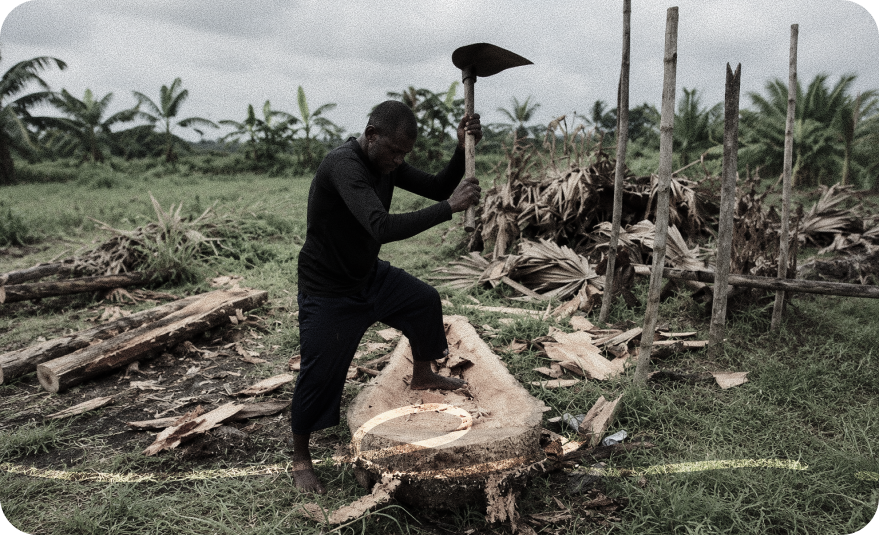
There is a man on the edge of Ikorodu who still speaks to wood.
His name is Baba Rasheed, and most mornings you will find him beneath a rusted zinc roof, not far from the lagoon's edge, bent over a hollowed log with a tool that looks older than he is. The adze moves in rhythms that seem almost musical, short and deliberate strokes that curl pale shavings onto the ground like sleeping things. He does not look up when you approach. The work demands that much.
I found him on a Tuesday, the kind of slow Lagos morning where the heat arrives before the sun does. I had been hearing about him from older traders at the Ikorodu waterfront, a quiet lagoon town on the eastern edge of Lagos, the man who still made canoes by hand. Not fibreglass. Not welded iron. Wood. Real wood. The kind that remembers the forest it came from.
"Nobody wants them anymore," he told me, without bitterness. He said it the way you say something obvious, like noting that the rains come late now. He has been carving since he was twelve, taught by his father, who was taught by his. Three generations of men who understood that a good canoe is not just a vessel. It is an argument made in timber, a negotiation between the carver's hands and the water's demands.
The irony of Ikorodu is this: it is a town that grew on the water. The lagoon gave it trade, gave it movement, gave it identity long before the expressway arrived and the developers followed. The fishermen who once launched carved canoes at dawn are still here, but many of them now use fibreglass boats bought from a distributor on Lagos Island. Lighter, cheaper, easier to repair. Practical. No one argues with practical.
But Baba Rasheed will tell you what practicality costs. A fibreglass boat sits on water. A carved canoe knows water. There is a difference in the way it responds to a current, the way it tips and corrects, the way an experienced paddler reads the lagoon through the hull. It is a kind of intelligence built into the material, centuries of observation encoded not in a manual but in shape, in depth, in the angle of the bow.
This is what disappears when a craft dies. Not just the object. The knowledge.
I watched him work for almost two hours.
The adze moved in short, controlled arcs, each stroke removing a thin curl of wood that landed softly on the pile already gathering around his feet. His hands knew exactly where to go. There was no measuring, no marking, no template. Just the eye, the wrist, and something deeper that lived below both. He would pause occasionally, run his palm along the curve of the hull, feel something the rest of us could not see, then continue.
At one point he stopped and looked up at me.
"You see this part here," he said, pressing two fingers against the inner wall of the canoe near the bow. "If this is too thick, the boat fights the water. If it is too thin, the water wins. You have to find the place in between. That place has no measurement. You just know it when your hand knows it."
He went back to work. I wrote nothing down. I just watched.
Occasionally a child would wander close, stare for a moment, then drift away toward the sound of a generator or a phone. None of them stopped long enough to ask what he was doing. That is the truest measure of how far a thing has moved from the centre of a community's imagination. When children no longer find it worth wondering about.
Baba Rasheed does not teach anyone. Not because he is unwilling. His own sons are in Lagos proper now, one driving a ride-hailing car, one doing something with computers. They visit on Eid. The younger fishermen who might have learned are chasing faster incomes. The knowledge, he says, simply has no one to go to.
There is a word in Yoruba, ogbon, that means wisdom, but also skill, also cleverness, also the particular intelligence that comes from having done something with your hands for a very long time. Baba Rasheed has ogbon in his shoulders, his forearms, the calluses on his palms. It is not the kind of thing you can photograph or upload. It lives in the body, and it will leave with the body.
When I asked if he was the last, he smiled for the first time. "In Ikorodu? Maybe. In the world?" He shrugged. "I don't know. I just know what I know."
He went back to the wood. The adze kept its rhythm. Somewhere behind us, the lagoon moved without hurry, the same water that has always been there, still waiting for boats that understand it.
Author's note: Baba Rasheed is a composite character drawn from craftsmen observed at the Ikorodu waterfront.