
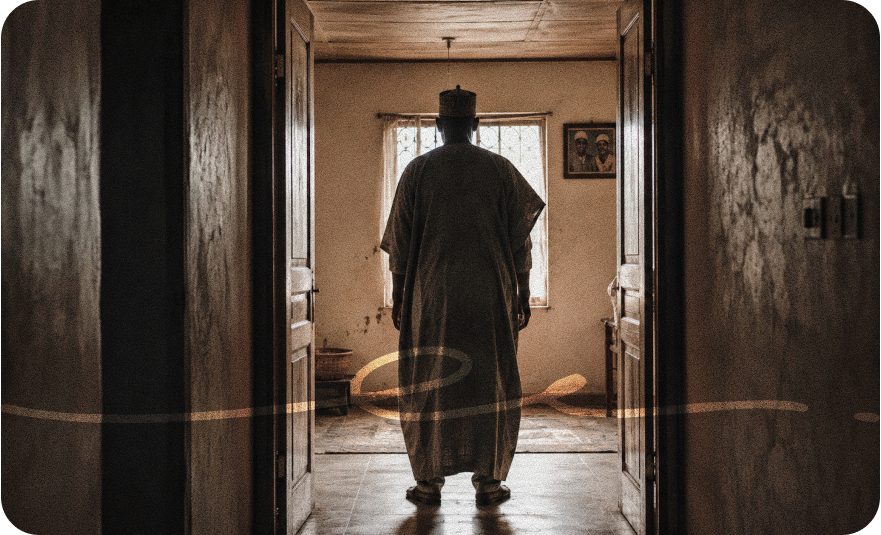
“Daddy is coming!”
The moment those words echoed through the house, everybody scattered. Some hurried to the sitting room, arranging the cushions and putting things back in their proper places. Others rushed into their rooms, making sure everything looked neat enough to avoid trouble. It was our normal evening routine. We became so familiar with it that we could recognize the sound of our father’s horn from a distance, and even the rhythm of his footsteps as he approached the front door.
The house had a rhythm of its own. Before my father came home from work, it was full of life. We laughed loudly, chased one another around the house, played without thinking twice, and filled every corner with noise. But the moment we heard his horn, everything changed. The laughter disappeared. Conversations stopped halfway through. Our bodies reacted before our minds did. The house became so quiet that it almost felt like a graveyard.
Looking back now, I often ask myself whether what we felt was respect or fear. As children, we didn’t know the difference. We only knew that if things were out of place, there would be consequences. If the sitting room was untidy, if we had been too noisy, or if we had done something wrong, shouting was almost certain. Sometimes it ended with flogging or another form of punishment. We learned very early that peace depended on everything being in order before Daddy walked through the door.
Even my mother, without meaning any harm, unknowingly reinforced that fear. Whenever we misbehaved, she would say, “I’ll report you to your father,” or “Your father is coming.” My father became more than a parent; he became the consequence. Before we truly knew him as a man, we knew him as punishment. Without realizing it, we began to see him as someone to avoid rather than someone to run to.
As children, we whispered to one another so Daddy wouldn’t hear us. If we wanted to ask him for something, we made sure we had been on our best behavior first. We cleaned the house, stayed quiet, and tried to do everything right, hoping it would increase our chances of hearing “yes.” Growing up, I never really saw him joke around with us. I can’t remember seeing him smile the way my mother did. Everyone, both inside and outside our family, knew him as a disciplinarian. He carried himself with authority, and we responded with caution.
Fear did exactly what it was supposed to do.It kept the house clean. It made us obedient.It made us careful.But it also made us careful around him. The strange thing was that the moment he wasn’t home, the house breathed again. We laughed louder. We played longer. We weren’t constantly listening for footsteps or waiting to hear our names called from another room.
Whenever we heard he was travelling, we celebrated.Sometimes we even prayed he would stay away for months.It feels cruel to admit that now, but it was true.
Years passed.The children who used to scatter at the sound of a horn became adults. These days, my father wants conversation.He wonders why we can spend an hour talking to our mother but end our calls with him after a minute or two. Sometimes he asks why we always seem to have stories for her but so few for him.
Whenever he says it, my mind goes somewhere else.It goes back to a little girl lowering the television volume before the front door opened.It goes back to siblings whispering so they wouldn’t be heard.
It goes back to a house that became silent every evening at almost the same time.
I don’t think my father meant to build distance.Like many fathers of his generation, he probably believed discipline was the highest expression of love. Being feared meant being respected. A good father was expected to be firm, unyielding, and in control. By those standards, he was a good father.
I understand that now in a way I couldn’t as a child.But understanding something doesn’t erase what it felt like to live through it.Even today, I notice pieces of that little girl following me into adulthood. When someone in authority wants to speak with me, I immediately search my mind for what I might have done wrong. I prepare explanations before I’ve even heard the question. I still find myself trying to earn approval before asking for anything.
Sometimes I wonder if that’s where it began.
My father and I speak now. Our conversations are kinder than they used to be. We’re both older. We’ve both changed.
But every now and then, I catch myself searching for words that come so easily with my mother and refusing to come with him. The silence isn’t intentional. It’s just… familiar.
I don’t believe love was absent from our home.I think it was simply spoken in a language I was too young to understand.
Children don’t always remember the sacrifices their parents made. They don’t see the worries carried to work each morning or the burdens hidden behind strong faces.They remember something simpler.They remember how home felt.
Sometimes I catch myself thinking about those evenings again.“Daddy is coming.”
The words no longer send anyone running.
The sitting room no longer falls silent.
No one rushes to straighten the cushions.
But somewhere inside me, I think that little girl still pauses for a moment, listening for a horn that has long since faded into memory.
And perhaps that is the quietest proof that some forms of love arrive only after fear has already made itself at home.