
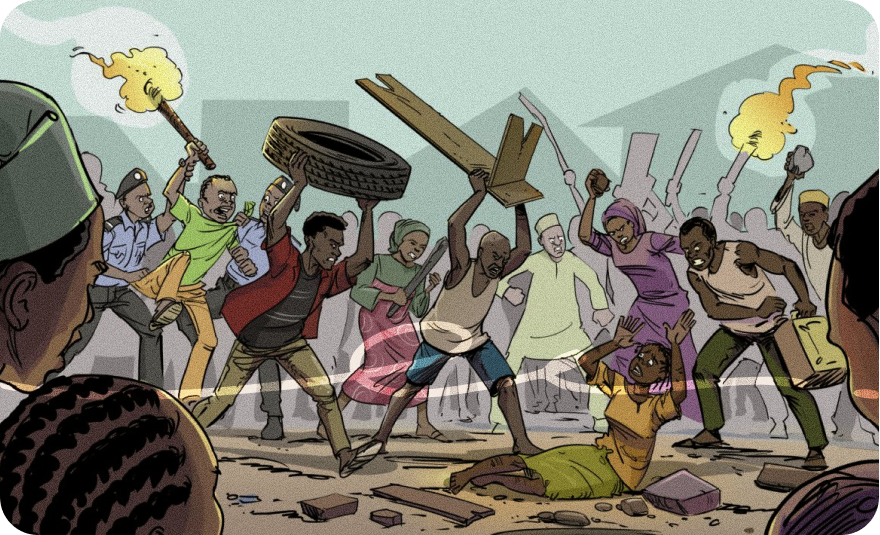
On the morning of October 5, 2012, four young men left their hostel at the University of Port Harcourt to collect a debt in a small village called Aluu. Lloyd Toku Mike, Ugonna Obuzor, Tekena Elkanah and Chiadika Biringa were roommates, friends, and, by the sort of coincidence a family notices only afterward, each the first son of his household. What happened to them next is now, in this country, close to a fixed point in the national memory: they were accused of theft, a crowd formed around the accusation faster than any fact could have travelled, and by the time the crowd was finished, the accusation had never once been tested by anyone whose job it was to test it, not a police officer, not a magistrate, not a single person with the standing to say wait, let us first find out. Someone filmed it. The footage is the reason the country knows the name Aluu at all; the mechanism itself was never new. It took five years for the case to reach a verdict, and when it did, only three of the accused were convicted, while others walked free for lack of proof; a gap between how fast the crowd was certain and how slowly, if ever, the law could be, that has repeated itself in almost every case since.
This is worth sitting inside rather than summarising, because the summary is where the lesson usually gets lost. A crowd, in the moment it forms around an accusation, is not weighing evidence. It has no evidence yet, and it doesn't wait for any. What it has is a shape it already recognises: "thief", and recognition moves at a completely different speed than judgment does. Judgment is slow on purpose; it is built out of the friction of a second telling, a cross-examined witness, a person whose entire function is to interrupt certainty with a question. A crowd has no such person inside it. It has only the story, arriving all at once, and everyone in it reaching the same false certainty in the same few seconds, together, which is precisely what makes it feel less like an individual failure and more like a shared and almost communal kind of knowing.
The name for this is jungle justice, and despite how modernized the world has become, this act, originally practiced in lawless societies in early civilization, has adapted to every new civilization. In May 2022, a 200-level student named Deborah Samuel sent a voice note to a WhatsApp group at the Shehu Shagari College of Education in Sokoto, asking that religious messages be kept off a page meant for coursework. Classmates decided the message was blasphemous. A crowd gathered on campus faster than the school authorities, who tried to move her to safety, could get her off the grounds. That same month, in Lagos, a sound engineer named David Imoh was lynched by a group of okada riders in the Lekki area. In November 2020, in Effium, Ebonyi State, traders accused a ten-year-old boy named Ifeanyi of stealing a small measure of uncooked rice; he was tied up and set alight before neighbours intervened and pulled him out. In 2022, in Auchi, a teenager was burned to death over an accusation of stealing a motorcycle. North and south, Christian towns and Muslim ones, the accusation changes but the crowds verdict are always the same; death before proven guilty. The mechanism that turns an accusation into a death sentence within minutes does not.
The scale of it resists being treated as a string of isolated cases. An intelligence report gathered by SBM nationwide between January 2019 and May 2022, counted 391 people killed by mobs in 279 separate cases and, against the easy assumption that this is a northern or a strictly religious phenomenon, this report also found that more deaths were recorded in the southern states than in the north over that period. Amnesty International, working from a longer window, documented well over five hundred people killed this way between 2012 and 2023. Every one of those deaths happened in a country whose constitution, in its thirty-third section, guarantees the right to life and forbids anyone from taking it outside due process of law.
None of this happens in a vacuum, and it would be its own kind of flattening to write it as pure savagery with no cause. It happens in the space left behind by institutions people have learned not to trust: a police report that goes nowhere, a court date that gets adjourned six times, a system where the honest expectation, based on years of watching it fail, is that the accused will either bribe his way out or the file will simply gather dust. Where that expectation hardens, a crowd starts to look, to the people inside it, less like a mob and less like murder and more like the only justice available on short notice: swift, visible, and free. That self-belief is the most dangerous part of the mechanism, more dangerous than the tyre, stone, or the match used to give a murder verdict, because it means the people inside the crowd rarely leave it thinking of themselves as anything other than instruments of a justice the state failed to provide.