Why Nigerians beg celebrities for the things they should be demanding from politicians, and why every participant helps keep the loop in motion
Step into the comment section of any major Nigerian musician, actor, or internet celebrity, and you will witness a parallel state system at work. Beneath photos of luxury cars, designer outfits, and sold-out arenas, the comments read like a national register of emergencies: hospital bills, tuition fees, eviction notices, stories of families who have not eaten for days, and accounts of police extortion. Thousands of ordinary citizens fill these spaces with pleas, hoping to be noticed and frequently repeating the same desperate prayer: "Grace, go find me."
To an outside observer, this might look like extreme celebrity worship. But it is not. It is a rational survival strategy, one that earned the most populous Black nation a social media moniker in February 2026, when Namibians on X, watching Nigerians ask a visiting American streamer for money, renamed the country Abegistan.
A closer look reveals something more complicated. This culture of public begging is not only a response to desperation; it is also part of a self-sustaining system in which private individuals quietly take on the responsibilities of the state. Nigerians do not pressure celebrities because they are confused about who governs them. They do it because celebrities appear more accessible and responsive than elected officials. When local governments, courts, hospitals, and welfare institutions fail, popular-culture figures become the country's unofficial safety net.
Yet beneath this reliance lies a deeper and more transactional reality. Celebrity "saviorism" provides immediate relief to a fortunate few. Still, it also rewards stars with attention and influence, allows politicians to escape accountability, and leaves the institutional failures that created the crisis untouched. Whether intentionally or not, every participant helps keep the loop in motion.
The Actors in the Loop
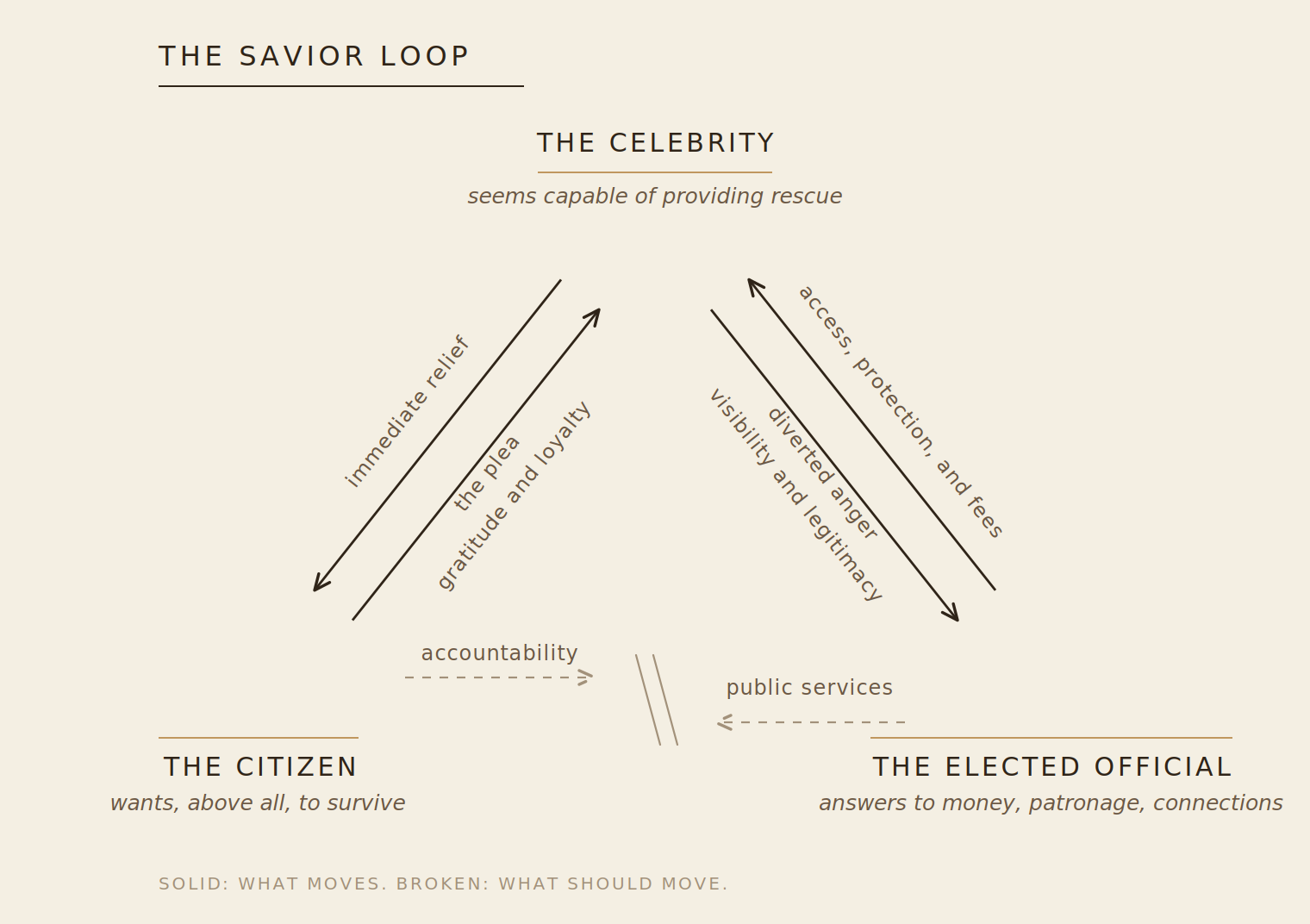
To understand the savior loop, we must first identify its three main participants.
The Elected Official: The politician is elected to improve public welfare through policies, programs, and public institutions. In a functioning democracy, the officeholder answers to the public. In Nigeria, however, political power often depends more on money, patronage, and connections than public service. The distance between what the office promises and what it delivers creates the space in which the loop grows.
The Celebrity: This can be anyone who has money or, in internet terms, anyone who can convincingly appear to have it. The performance of wealth matters because it makes the celebrity seem capable of providing rescue. A large following, combined with direct or indirect access to politicians, strengthens that appearance of power and legitimacy.
The Citizen: The citizen may be rich or poor, but still depends on the state for basic services, public infrastructure, security, justice, healthcare, and economic stability. Above all, the average citizen wants to survive.
These three participants sustain the loop, knowingly or otherwise. Each also appears to offer a pathway into the next level of power. These positions are not always fixed. In a society where visibility can be converted into wealth, access, and political influence, the citizen may aspire to celebrity, the celebrity may seek proximity to political power, and the politician may use celebrity visibility to appear connected to the public without becoming directly accountable to it.
Now picture the most ordinary version of the loop in motion. A child needs four million naira for surgery, and the family has run through everything: relatives, the village association, the church, the WhatsApp broadcast. Finally, someone posts the medical documents online and tags a celebrity. He sees it. He pays. The comments do what they always do: "God, when", "more blessings, king or queen," "this is why we love you."
The child lives, and that is real. It should not be dismissed.
But the public rarely considers what else has happened. A failure of the state has been transformed into a personal favor. The government is relieved of responsibility for a healthcare system in which a child's survival depends on whether a celebrity happens to see a post at the right moment. The anger that should have been directed at the empty hospital, the missing insurance system, or the vanished health budget is converted into gratitude toward a private individual.
Multiply this by every medical bill paid, every tuition fee covered, and every police officer publicly shamed into action, and the pattern becomes clear. The celebrity receives admiration. The politician remains untouched. The public anger required for institutional reform is temporarily released. The loop functions as a pressure valve for a failing state.
No one needed to design it. Everyone involved receives enough of a reward to keep it running. That is what makes it difficult to break.
From Fela to the Giveaway
The expectation that entertainers should carry the burden of the state has a history, but that expectation has gradually been turned on its head. In the 1970s and 1980s, Fela Anikulapo Kuti used Afrobeat as a weapon of political defiance. Through his music, he confronted military rule, corruption, and human rights abuses, and he paid dearly for it. In 1977, soldiers burned his Kalakuta compound. His mother, the activist Funmilayo Ransome-Kuti, was thrown from a window and later died from her injuries. Fela himself was repeatedly beaten, arrested, and imprisoned. Through that sacrifice, he helped establish a powerful idea in the Nigerian imagination: a true cultural icon should be willing to confront political power.
As Nigeria returned to democracy in 1999, contemporary entertainers inherited some of Fela's cultural influence. But stardom had become a lucrative and globally exportable business. Public attention shifted away from barricaded military rulers toward the glamorous worlds of Nollywood and, later, Afrobeats.
Social media completed the inversion. Fela's stature came from what he was willing to risk. The new celebrity's power came from the ability to hold attention. Anyone who could attract enough viewers, for almost any reason, could become famous overnight. The metric had flipped: from what you were willing to risk to how many people were watching.
One of the easiest ways to attract and retain that visibility was the “giveaway”. It began with small gifts: airtime, recharge cards, and modest cash prizes posted online or dropped into comment sections. Then the amounts grew. Celebrities began giving away cash, phones, products, and other rewards. Brands noticed the engagement and built marketing campaigns around the same lottery-style model. Celebrities could now rent their reach to companies willing to pay for access to their audiences.
The giveaway became sustainable because it filled a real institutional vacuum. It occupied the space where functioning welfare programs should have existed. With every round, it reinforced the same lesson: the place money comes from is not an office or a program but a person with a following. By the time a struggling citizen needs assistance, all familiar signals point toward the celebrity. Rather than search for a government agency or public policy that may not function, the citizen searches for someone famous enough to intervene.
This informal arrangement became so normalized that in July 2026, at the launch of a national community food bank in Lokoja, the First Lady could publicly call on Burna Boy, Davido, and Asake to help people experiencing poverty with their money. The burden on the government is huge, she said. The request did not create the system. It merely asked celebrities to do more within a system that politicians had already learned to use, especially during election periods.
The substitution also developed a justice version. When citizens faced unlawful arrest, police extortion, or illegal detention, many learned to tag a celebrity or influencer rather than file an official complaint. Often, the strategy worked. A post from the right person could draw enough attention to secure someone's release. But the intervention also redirected public anger through a private individual. It strengthened the relationship between the celebrity and the powerful officials who could "sort" the situation, while the victim remained grateful and dependent.
The immediate problem was resolved. The institution remained unchanged.
These two reflexes, begging the celebrity for money and tagging the celebrity for justice, came together nationally during the October 2020 #EndSARS protests against police brutality. As young Nigerians filled the streets, some of the country's most prominent entertainers amplified the protests internationally. Actors and comedians marched in Lagos. Musicians used their platforms to spread information. When soldiers opened fire at the Lekki Toll Gate, it was a performer's phone broadcasting on Instagram Live, rather than a traditional news camera, that carried the violence to hundreds of thousands of viewers in real time. The lesson was profound: official institutions appeared unresponsive, but pressuring a celebrity could attract global attention and force a frightened government to react.
After 2020, large-scale street mobilization receded, even as inflation and fuel prices climbed. Digital pressure on celebrities, however, intensified. A small group of entertainers increasingly became stand-ins for millions of Nigerians whose experiences and demands they could not fully represent. The celebrity became an all-purpose institution: the welfare office and the petition, the lottery and the lawyer.
Instead of directing anger toward government secretariats and elected representatives, citizens frequently launched social media campaigns demanding that major artists speak out. The contradiction becomes most visible every December. Nigerians spend hundreds of thousands of naira filling arenas for Afrobeats stars, then return online the next morning to ask those same stars to pay medical bills, fund education, challenge police abuse, and condemn government policy.
The celebrity became more central to public life precisely as the state withdrew from it.
Governing From the Direct Messages
The breakdown of Nigeria's official systems has pushed citizens to bypass traditional democratic channels. Nigeria lacks a functional unemployment-benefit system and an effective public healthcare safety net. The ministry intended to provide humanitarian assistance and alleviate poverty has, in the public imagination, come to represent the opposite of its name.
In January 2024, its sitting minister was suspended over allegations involving ₦585 million in welfare funds transferred through a private bank account. Investigators also traced ₦37.1 billion allegedly laundered under her predecessor, through a contractor, across dozens of bank accounts. The money was intended for some of the country's poorest citizens. When the institution responsible for alleviating poverty becomes associated with the mismanagement of poverty-relief funds, citizens stop expecting it to help. A celebrity announcing a giveaway on Instagram or X effectively becomes the administrator of a decentralized welfare office, and, for some Nigerians, a more responsive one than the official ministry.
The same institutional bypass occurs within the justice system. The police and judiciary are widely perceived as slow, expensive, and vulnerable to bribery. A citizen facing illegal detention or police extortion may file a complaint and receive no response for months. A viral post from an influencer with millions of followers, however, can immediately threaten the public image of the police high command. In Nigeria, an Instagram post can secure the release of an innocent citizen faster than the formal complaint process.
Political representation, meanwhile, often feels invisible. National Assembly members and governors move behind tinted SUVs, armed escorts, and fortified residences. Many are inaccessible to the voters they represent. Celebrities, by contrast, appear to be only one comment, tag, or direct message away.
The Shield: How the Loop Protects Politicians
Treating entertainers as alternative public institutions creates an effective political smokescreen. While public outrage is consumed by arguments over whether a musician has spoken, remained silent, donated enough, or shown sufficient concern, elected officials at every level escape direct scrutiny.
At the federal level, the executive operates with limited public accountability. Amid a devalued naira, record inflation, and controversial economic policies, the presidency can sidestep media inquiries and public demands for clearer explanations of government spending. It can do so partly because much of the public's immediate frustration is directed elsewhere.
At the state level, the failure is especially visible in the relationship between governors and local governments. On 11 July 2024, the Supreme Court delivered a landmark judgment granting financial autonomy to Nigeria's 774 Local Government Areas. It ordered that federal allocations be paid directly to elected local councils and rejected the continued misuse of state and local joint accounts. It also ruled that governors' caretaker committees were illegal.
The states complied with the part that cost them nothing. Council elections were hurriedly conducted because allocations would be withheld without elected officials in place, and the caretaker committees went. The joint accounts stayed. In the first year after the judgment, an analysis of federation account data found that governors retained control of ₦4.5 trillion in local council funds through the same system the court had condemned. In the first quarter of 2026, states still controlled the ₦1.46 trillion allocated to the councils through that mechanism. Two years after the ruling, the figure had reached roughly ₦10 trillion.
On the money, the apex court spoke; the governors did not move.
At the grassroots, council chairpersons and ward councilors often depend politically on the governors who placed or supported them. Allocations intended for primary health centers, sanitation, rural roads, and other local services receive little meaningful public oversight. Many local officials hold no regular town halls and maintain little visible contact with residents. So, when a clinic runs out of medicine, or a road becomes impassable, the young people in that community rarely march to the council chairman's office. They log on, tag an influencer, and beg for a borehole.
The VVIP Room: A Shared Circle of Elites
The expectation that celebrities will rescue citizens from political failure overlooks an obvious conflict of interest: celebrities and politicians often move within the same elite circles. They attend the same exclusive parties, destination weddings, private celebrations, and VVIP events. Their relationships are not merely social; they are often financial. Politicians control access to public resources and political influence. Celebrities control access to public attention.
During election campaigns, government events, and private celebrations, political elites pay entertainers to perform, promote events, or lend cultural legitimacy to their gatherings. The trade is not always disguised. In a BBC investigation before the 2023 elections, a party operative described paying an influencer as much as ₦20 million to deliver a result. It said others preferred to be offered a seat on the board or a role in government rather than cash.
A celebrity is unlikely to dismantle a political structure whose gatekeepers are also clients, patrons, friends, or sources of access. This produces a betrayal that the public repeatedly witnesses: their favorite stars drinking champagne with the very people responsible for the inflation, scarcity, and institutional decay they are later asked to condemn or relieve. That contradiction is central to the loop.
The Business of Being a Savior
Playing the savior is rarely an act of pure charity. In the digital economy, attention is currency, and saviorism generates enormous attention. When an influencer pays a viral medical bill or takes up a citizen's fight, engagement rises, videos trend. Follower counts increase. The celebrity's value to the algorithm, and to advertisers, grows. Companies in industries such as telecommunications, banking, and financial technology seek personalities who command broad public trust. A reputation for generosity and public intervention builds exactly that trust.
Saviorism buys more than commercial value. It also buys protection. A celebrity with millions of loyal followers becomes difficult to confront publicly. Attacking or arresting a beloved star can trigger widespread outrage. Rather than fight such figures, politicians often seek to co-opt them by offering access, recognition, protection, appointments, or proximity to power.
This is the engine room of the loop. Citizens beg because begging sometimes works. Celebrities give because giving strengthens their brands, influence, and public protection. Politicians tolerate the arrangement because celebrity intervention absorbs anger that might otherwise be directed toward the state. None of it requires a villain. It only requires three sets of people each doing the locally rational thing, and an arrangement in which the rational thing, repeated, quietly forecloses reform.
Breaking the Loop
The cruelty of the savior loop is that every act of relief can solve an immediate crisis while leaving the underlying structure untouched. A celebrity who pays a medical bill may save a life, but the intervention does not build a hospital or create a functional insurance system. An influencer who publicly pressures the police may secure a victim's release, but the intervention does not reform the force or prevent the next unlawful detention. By repeatedly patching the symptoms of institutional failure, celebrity saviors reduce the pressure that might otherwise force the state to address the underlying disease.
Charity becomes a pressure valve. It releases public frustration before that frustration can threaten the institutions and officials responsible for the crisis. For the elite, the arrangement is comfortable. Politicians continue to mismanage public resources behind closed doors. Celebrities receive admiration, influence, and commercial value by managing some of the resulting damage. The ordinary citizen remains dependent on charity for services that should be guaranteed as rights.
The problem is not that celebrities help. A person facing illness, hunger, eviction, or police abuse cannot be expected to reject the fastest available route to survival in the name of political principle. The problem begins when private rescue becomes the end of the story.
Every successful intervention should lead back to the institution that failed. When a celebrity pays a hospital bill, the public should also ask why the treatment was inaccessible, which agency was responsible, what happened to the relevant budget, and how many other families remain unseen. When an influencer helps secure the release of a detained citizen, the conversation should go beyond gratitude. It should identify the officers involved, examine the failed complaint system, and demand safeguards to prevent repetition.
Celebrity visibility should amplify institutional accountability, not replace it. As long as Nigerians continue to treat entertainers as the final source of the dignity they should demand from elected officials, the nation will remain trapped in the savior loop, governed by hashtags, fueled by giveaways, and deprived of sustainable governance.
Sources
Ordered as they appear.
"Abegistan", coined February 2026 during an exchange between Nigerian and Namibian users on X, in the course of IShowSpeed's Africa tour. The Guardian, "Abegistan" trends as new nickname for Nigeria after IShowSpeed's Lagos stop, 4 February 2026. https://guardian.ng/life/life-features/abegistan-trends-as-new-nickname-for-nigeria-after-ishowspeeds-lagos-stop/
The First Lady's appeal to Burna Boy, Davido, and Asake, and "the burden on the government is huge", at the launch of the National Community Food Bank Program in Lokoja, Kogi State, 11 July 2026. Pulse Nigeria, 13 July 2026. https://www.pulse.ng/story/first-lady-calls-on-davido-burna-boy-asake-and-others-to-help-poor-nigerians-says-the-burden-on-the-government-is-huge-2026071309051217000
The suspension of the Minister of Humanitarian Affairs and Poverty Alleviation, 8 January 2024, over a memo directing ₦585,198,500 into a private account. Arise News, 8 January 2024. https://www.arise.tv/tinubu-suspends-humanitarian-affairs-minister-betta-edu/
₦37,170,855,753.44 allegedly laundered under the preceding minister through a contractor, across 38 bank accounts. EFCC documents, December 2023, reported in PUNCH, 4 January 2024. https://punchng.com/exclusive-%E2%82%A637-1bn-fraud-why-i-didnt-honour-efccs-invitation-ex-minister/
Supreme Court judgment on the financial autonomy of the 774 Local Government Areas, 11 July 2024, including the ruling on joint accounts and caretaker committees. Reported in PUNCH, 11 July 2025. https://punchng.com/autonomy-standoff-govs-get-n4-5tn-lg-funds-one-year-after-scourt-ruling/
₦4.5 trillion, more precisely ₦4.496 trillion, in council allocations routed through state governments between July 2024 and June 2025. Analysis of Federation Account Allocation Committee data, PUNCH, 11 July 2025, corroborated by BusinessDay, 2 November 2025. https://punchng.com/autonomy-standoff-govs-get-n4-5tn-lg-funds-one-year-after-scourt-ruling/ and https://businessday.ng/life/article/fiscal-freedom-still-eludes-lgs-16-months-after-supreme-courts-ruling/
₦1.46 trillion controlled by states in the first quarter of 2026, and Section 162(6) of the 1999 Constitution as the surviving basis for the joint accounts. PUNCH, 14 May 2026. https://punchng.com/lgs-supreme-courts-problematic-judgement/
Roughly ₦10 trillion in council allocations two years after the judgment. PUNCH, 16 July 2026. https://punchng.com/autonomy-battle-states-defy-supreme-court-control-n10tn-lg-allocations/
The party operative's account of paying an influencer as much as ₦20 million for delivering a result. BBC investigation into the 2023 elections, carried by Daily Trust, 22 January 2023. https://dailytrust.com/nigerian-elections-2023-how-influencers-are-secretly-paid-by-political-parties/