
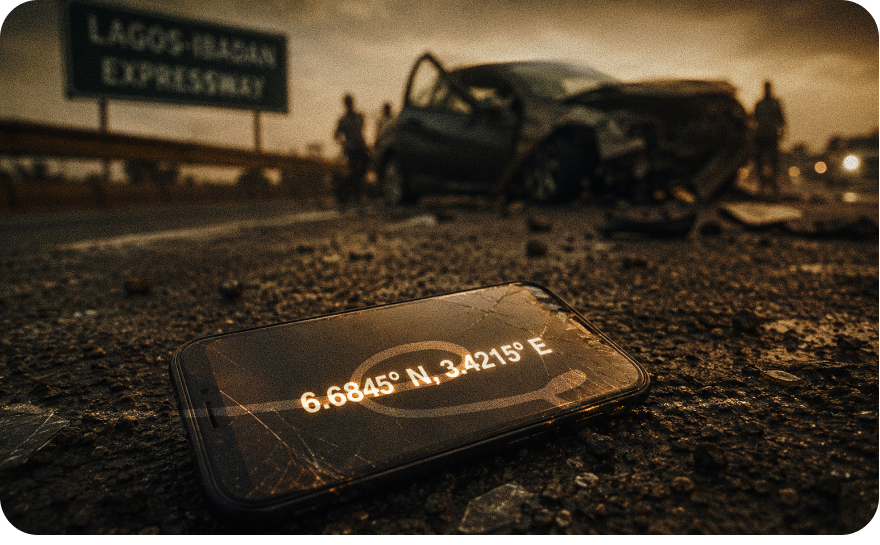
Somewhere on the asphalt expanse of the Lagos-Ibadan Expressway, a car came to a violent stop.
Shade knew the exact time the call came in. What she did not know was the driver’s name. What she knew was what the phone knew, and the phone knew enough to save a life.
It knew the moment of impact, the angle of collision, the sudden deceleration that no voluntary human movement produces. It knew the GPS coordinates to four decimal places: 6.6845° N, 3.4215° E. It knew that its owner had not responded in twenty seconds and so, the way a loyal and terrified witness might, it did the only thing it could.
It called for help. The call connected. A voice on the other end answered."112 Emergency Services."
And this is where the story stops being about technology and starts being about us.
The emergency call agent who received that signal had, in their hands, one of the most precise pieces of life-saving information a human being can receive: the exact location of someone who needed help, transmitted automatically, without ambiguity, by a device that had done its job completely.
What followed was not a swift dispatch.
It was a debate.
Two agents and their supervisor. Two answers.
The first listened to the automated telemetry and guessed at the long stretch near the Long Bridge, just outside the Lagos border, where traffic bottlenecks meet high-speed vulnerability. The second insisted it was further up, past the Mowe-Ibafo axis, nearing the industrial clusters where the highway darkens at night. Same expressway. Different response units. Different hospitals. Different chances.
The iPhone had done its job with flawless precision. The institution it called had no map. The technology did not fail. It stood as a solitary monument to functionality in a landscape of collapse.
I have thought about that moment many times since I heard Shade and a colleague in our emergency services discuss the call. I think about the agent who guessed the Long Bridge. If you look past the cold mechanics of the dispatch log, you find a profound, hidden terror in that room. The agents were not careless; they were desperate. Imagine the psychological weight of sitting at a desk, hearing the iPhone's automated, robotic voice repeat coordinates over a live line, knowing a human life is slipping away, and realizing you are entirely blind. It is a specific kind of professional torture.
They were improvising heroically in the gap where infrastructure should be, their minds racing through mental geography in place of digital mapping. The first agent's voice carried the panic of a gambler forced to wager with someone else's survival. The second agent's disagreement is born out of a protective instinct, knowing that sending a team eighty kilometers in the wrong direction is a death sentence. The human brain was forced to substitute for the tools that the budget had allocated, and the corruption had consumed.
This is what institutional decay looks like at the moment it costs something. Not in a committee report. Not in an audit finding, but in a wrecked car on the country's most vital economic artery, where someone's coordinates are being debated by people who were never given the tools to stop debating.
I want to talk about what a functioning system would have looked like, because I think we have lived so long inside dysfunction that we have stopped being able to imagine the alternative with any specificity.
Let us sit with the coordinates for a moment, because they matter more than they might appear to. 6.6845 degrees North. 3.4215 degrees East. These are not difficult numbers. They are two decimal figures that any smartphone, laptop, or internet-connected computer can use to resolve a precise location in seconds.
Google Maps would drop a pin. What3Words would produce three ordinary words.
A basic GIS dispatch platform, the kind emergency services in functioning states have used for decades, would automatically calculate the nearest ambulance, the fastest route, and the nearest emergency care facility. None of that happened. Because none of it existed in the form that this call required.
And here is where the reflection becomes painful.
The emergency infrastructure was not absent because nobody thought of it. Plans have been written. Proposals have been drafted. Budgets have been announced. Somewhere between conception and execution, however, the system disappeared into the familiar fog that swallows so much public ambition.
The coordinates were correct. The casualty was real. The gap between those two facts and a working response is the precise measurement of institutional failure.
Shade spoke about the call with the particular exhaustion of someone who has worked inside a broken system long enough to stop being surprised by the breaking.
What struck me was not the anger in her telling—there was some—but the normalization. The way the story was offered as an example of how things work, not as an outrage. As texture, not as crisis. That normalization is its own kind of catastrophe.
Because the moment a society stops being outraged by the gap between what its institutions should do and what they actually do, the gap stops being experienced as a failure and starts being experienced as a feature.
The emergency service that cannot locate a crash becomes simply the emergency service.
The coordinates that produce debate rather than dispatch become simply the coordinates.
The person in the wrecked car becomes simply another statistic or does not become a statistic at all, because nobody came, and nobody recorded it, and the highway carried on.
There is a number attached to that silence. Nigeria’s roads kill thousands of people every year. A significant portion of those deaths is not instantaneous. They are the deaths of people who would have survived the impact.
People who were conscious and breathing. People who would have remained so with timely intervention. People who died not from the crash itself, but from the absence of what should have come after it.
Somewhere along the Lagos-Ibadan Expressway, a phone transmitted a location with mathematical certainty.
The tragedy was not that nobody knew where the victim was.
The tragedy was that the knowledge arrived before the institution was capable of using it.
The signal reached. It always reaches.
What we have not yet built is something worth reaching.