
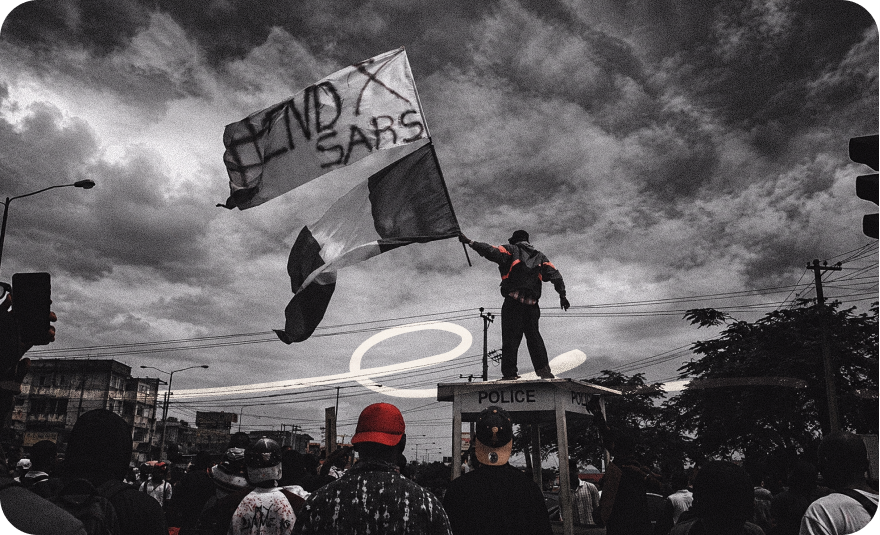
I was at Lekki Toll Gate on the night of October 20, 2020, filming the protest the way I had been doing for hours, nothing in the footage yet suggesting what was coming. We had been there since afternoon, part of the #EndSARS crowd demanding an end to police brutality, singing, chanting, holding the kind of hope that a crowd that size can manufacture out of nothing but its own numbers. Then the Lagos State curfew was announced, and something in the air changed before anything visible did.
I stayed anyway, with the others who stayed. When the soldiers and police arrived and the gunfire started, I crouched down the way instinct tells a body to crouch, phone still in hand, and a spent bullet shell landed on the ground beside me. I do not have better words for what happened in me at that exact second than to say it felt like something left my body: not my life, exactly, but whatever part of a person keeps them standing upright by default, gone all at once.
Still low to the ground, I started singing the national anthem. I do not fully know why, even now, except that some reasoning moved through me faster than I could examine it: if we were going to die there, I wanted it known that we died for a cause and a country we actually believed in, not simply as bodies caught in a crossfire nobody outside that toll gate would understand the shape of. Other protesters around me took each other's hands, and the anthem spread low across the ground the way singing does when people are too afraid to stand but not afraid enough to stay silent.
Up until the time the gunshots rang out, this protest mostly involved the idea of collective action, wherein individuals participate because they think it is the right thing to do, and also remain (knowing it) safe with their own lives in the process. However, that bullet shell caused the instant trip into another realm of fear altogether. From that moment on, survival became the only consideration. Everything else including the crawling, the running, and the eventual escape towards the hospital, happened inside that new and more limited fear.
What has stayed with me longest is not actually the fear, though it was real and total in the moment. It is what I chose to do once it passed. I did not stop attending to what had happened, did not let the morning after become the end of my involvement. I kept talking about that night, kept sharing what I had filmed and witnessed, in whatever rooms and conversations would have it, long after the news cycle had moved on to other things. Amnesty International would later conclude that security forces killed at least a dozen peaceful protesters at Lekki and Alausa that period; a leaked report from the Lagos Judicial Panel would go further, describing it plainly as a massacre, live ammunition fired into a crowd that had not fired anything back. I did not need those reports to know what I had seen. I have simply been grateful, since, that they exist for the people who did.
I still have that shell casing's exact weight in my memory, the specific dull sound of it hitting the ground beside my knee. I have never gone looking for the actual object since. I do not think I need to hold it again to remember precisely how light it was, and how heavy everything that followed it turned out to be.