
She stared into open space.
“The morning sickness…”
“The changes in appetite…”
“The irritation…”
Her menstrual cycle had not yet returned after having her baby—her first child.
Then there was the mood.
“Chim oooo, I hope this is not it?”
“If this is exactly what I am thinking it is, then I am not ready for this. My body is yet to properly heal from the last one.”
You know that feeling—the one that comes when something you never imagined happening to you suddenly becomes a possibility?
She certainly was not ready.
This was not how the young woman had imagined her life. She had married a year earlier and had her first child the following year. She had thought she would rest for a while, plan for the future, perhaps start something of her own.
Having another baby was nowhere near the top of her to-do list.
“I was careful!”
She found herself struggling.
Internal struggles can be frightening. There is always chaos in trying to maintain a balance between what you want and what life hands you.
She had hoped to begin a small trade to support her little family. She was finally beginning to feel as though she was making headway.
But now, she was stuck again.
Stuck with a child who had barely clocked seven months in December—and possibly another tiny being forming inside her.
“What will people say?”
At the women’s group, there had recently been teachings about the importance of women prioritising their health, resting after childbirth and practising proper birth spacing.
She had agreed with every word. I mean, the invited speakers left no stone unturned. What better way to curb this menace than this kind of gathering?
In fact, she had resolved to wait two years, perhaps even three, before having another child.
It was no secret that maternal mortality remained a serious concern. She had heard countless stories of women who had suffered complications during pregnancy and childbirth. She had also heard that conceiving too soon after childbirth could increase certain health risks.
She wanted to heed the counsel. Of course, she agreed.
Multiply, yes, but with wisdom.
Yet here she was.
She was too frightened to visit a laboratory or even use a test kit. She had seen the signs. She knew the signs.
And then there was something else.
Her daughter had begun to wean herself.
At first, she thought perhaps the baby simply needed help. Her mother had taught her what to do when she came for Omugwo. She had told her to wash her breasts with arigbo and apply ude aki to encourage the milk to flow.
But the baby refused to suckle.
She kept wondering why.
After procrastinating for a while, she finally went to a nearby laboratory.
She needed to know.
The test confirmed what she had feared.
“Congratulations, Madam. Your pregnancy test is positive.”
The young doctor smiled.
She looked up at him and tried not to break down.
“Thank you, Doc.”
She managed a smile too.
But there were too many thoughts running through her mind, and fear occupied the largest space.
She got home as quickly as her legs could carry her. She neither greeted anyone nor responded to the greetings thrown her way.
She was already becoming conscious of her appearance. She did not want anyone to notice, not yet.
Not until she figured out what she was going to do.
But what was there to figure out?
This was not even negotiable.
She had been raised in a strict Catholic home. She had also married a Catholic Charismatic man. To her, terminating the pregnancy was unthinkable.
She called it murder.
So she cried.
She wailed.
She blamed herself.
Her husband, however, made her understand that he was there for her every step of the way. After all, it takes two to tango.
Then, as though God had heard her fears, her daughter stood.
She began walking the following month.
The young mother was happy. Fulfilled.
And, slowly, she stopped worrying so much about whether people would notice her growing belly.
She went about her days, counting down the months until she would welcome her second child. She was still worried, though.
She ate more.
She craved almost everything.
She grew bigger in no time.
It became almost comical.
She could trace an aroma to its source no matter how far away it was and, somehow, find her way there for a bite.
She carried a pot around almost as often as nursery toys remained in the hands of toddlers—something to keep her occupied and pacified.
Her mouth danced in unison with the harmony of every meal.
She began to wonder if she had developed a binge-eating disorder.
Still, she could not help herself.
Then came the scans.
The doctors became concerned.
By the final antenatal assessments, it was clear that she might not have the vaginal delivery she had hoped for.
The baby was still in a breech position.
The head was not down.
A difficult delivery was likely if she insisted on a vaginal birth, and the doctors warned her about the risks.
She came home with the medical report clutched in her hands and handed it to her husband through tears. He, in turn, handed the matter over to Jesus in the Blessed Sacrament at St. Michael’s Chapel.
Tacenda.
Perhaps that was his quiet way of encouraging her. And, being at peace with the situation too.
By then, fear had almost completely overshadowed all excitement.
Every day, she prayed that the cup of suffering would pass her by.
Then came 16 November 2002.
A battle began—one whose outcome no one could predict.
Everyone was willing to give their all.
The doctors and nurses moved around tirelessly, trying to help the young mother deliver safely. She believed she could still handle a vaginal delivery, especially with the support of her husband.
The doctor decided to indulge her.
If things did not progress safely, they would proceed with the original plan.
She was already eight centimetres dilated. The contractions tore through her like waves crashing against a stubborn shore.
She could neither explain what she felt nor find the words to describe it.
Everywhere seemed unbearably hot.
Only a wrapper shielded her from the world, and even that threatened to slip away.
She was tired.
Tired of walking.
Tired of exercising.
Tired of clapping.
Tired of singing.
Tired of praying.
She kept calling the nurses to check her.
“I am ready!” she screamed.
Eventually, she reached ten centimetres.
But the baby remained breech.
The baby had refused to turn.
It was almost as though she had signed an agreement with the universe.
A tough one indeed.
The doctor proceeded with the delivery.
The baby made her grand entrance—feet first.
It was a long, intense battle.
When the baby finally emerged, her tiny hands and legs were badly bruised and injured from the difficult delivery.
But there was something else.
Something terribly wrong.
The baby was still...
A STILL BIRTH
The doctor tried everything he could.
Nothing.
No cry.
No movement.
No response.
Finally, the doctor placed the tiny body on her mother’s chest.
Perhaps for the first and final time.
Then the baby was placed in an infant body bag to be taken for burial.
“What is happening?”
“Doctor, what is happening?”
“Why is she being placed there?”
“Nooooooooo!”
The woman began to scream.
“The devil cannot win against me! I suffered so much for this child!”
She was becoming inconsolable.
The medical practitioners feared for her safety.
Her husband was eventually allowed into the ward.
He spoke softly.
Gently.
He stayed with her until her screams became whimpers.
His eyes were filled with tears too heavy to remain behind their sockets, but he had another duty.
He had to remain strong.
So he faced it squarely.
Preparations to commit the baby to mother earth were already underway when Matron Chukwu walked in to check on the situation.
She met a crying woman.
She recognised her immediately.
The woman had been coming for antenatal care, and the matron often called her AGADI—an Igbo expression sometimes used informally to address a heavily pregnant woman.
Then she looked at the baby.
She froze.
“But this baby does not look like a dead child.”
She turned to the woman's husband.
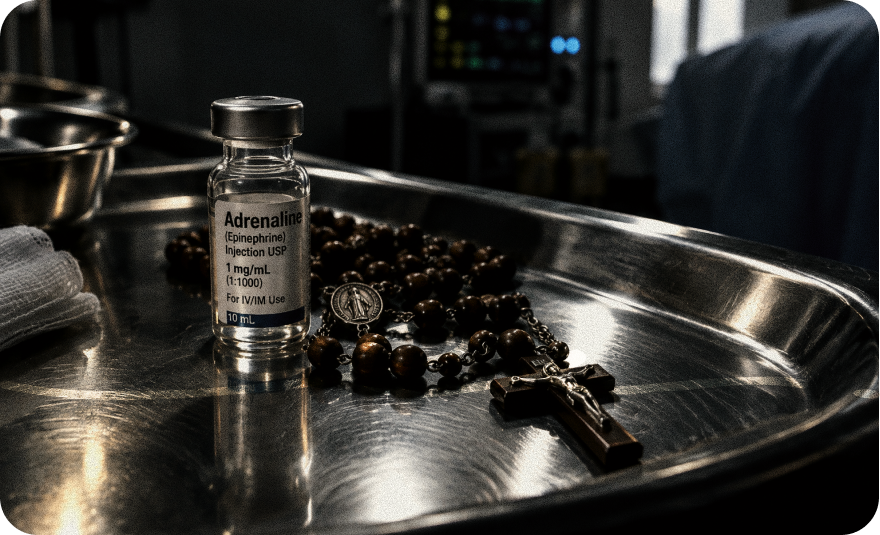
“Go to a pharmacy and get adrenaline. Let us try one more resuscitation.”
Perhaps the baby was simply too weak.
She did not say that aloud. She did not want to raise anyone's hopes.
But inwardly, she prayed.
Even for the faintest heartbeat.
Everyone prayed.
And then—
A faint cry.
Just one.
Tiny.
Fragile.
But to everyone in that room, it was the loudest sound they had ever heard.
A miracle.
Tears flowed freely.
This time, they were tears of joy.
Songs of praise filled the room.
The baby was immediately given the necessary care and closely monitored.
The medical records that had initially indicated a stillbirth were corrected to reflect a live birth.
Even after all that time, the baby weighed over 4.5 kilograms.
She was carefully observed and monitored until the doctors were satisfied that she was safe.
The name Miracle stuck from that day. The injured hands and legs eventually became a thing of the past as Grandma's warm baths, massages and careful attention during her Omugwo visit, helped nurse the baby (that's me by the way), back to strength.
And, as my parents tell it…
I am that baby.
Chinazaekpere.
God answers prayers.
A testament that there is an Omnipotent God who still answers prayers.